
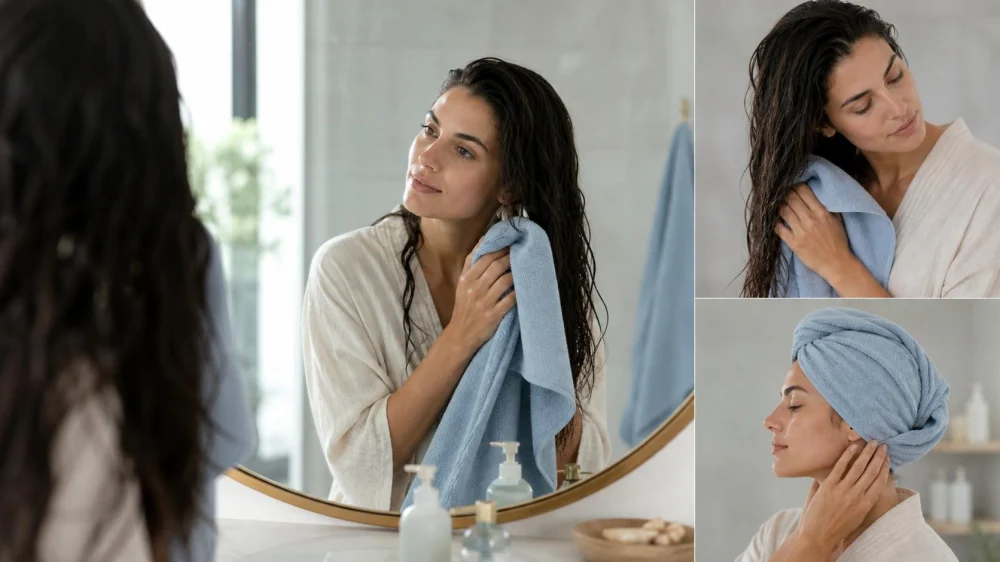
Hair Towel Routine: Blot, Wrap, and Dry Without Pulling
On this page
- Choose a suitable towel
- Prepare hair before drying
- Blot instead of rubbing
- Wrap with low tension
- Adjust for length, density, and texture
- Protect edges, scalp, and extensions
- Limit time in a wet wrap
- Combine with products and air-drying
- Wash and store hair towels
- Know when to change the routine
- Hair towel checklist
A hair towel routine removes excess water without rough friction or sustained pulling. The goal is not to make hair completely dry in a few minutes. Gentle blotting and a loose, well-supported wrap can shorten later drying while respecting wet strands, scalp comfort, curls, extensions, and fragile edges.
No towel method prevents all breakage or suits every scalp and hair condition. Stop if the wrap causes pain, headache, neck strain, itching, or pulling. Persistent scalp soreness, sores, sudden shedding, or hair loss deserves evaluation by an appropriate healthcare professional rather than a tighter styling routine.
Try the routine on a day without time pressure. Note how many minutes it takes to stop dripping, how heavy the towel feels, whether roots remain comfortable, and how the hair behaves after release. Change one variable at a time so you can tell whether fabric, size, pressure, or time made the difference.
Keep a dry backup towel within reach before washing. Reaching across a wet floor or walking through the home with dripping hair creates a slip risk. Use a bath mat with stable backing and clean any water around the sink or shower promptly.
Sport Clips Haircuts of Clybourn Square
2750 N Clybourn Ave, Chicago, IL 60614, USA
Choose a suitable towel
Select a clean, absorbent towel sized for the hair without becoming heavy when wet. Smooth microfiber, a soft cotton T-shirt, or a lightweight cotton towel may reduce friction compared with a thick rough bath towel. Personal preference and fabric care matter.
Inspect loops, seams, buttons, elastic, and hook-and-loop fasteners that can catch strands. Retire material with rough edges or exposed hardware. A dedicated hair towel should be easy to wash and dry fully.
Prepare hair before drying
Finish rinsing according to the product instructions. Gently squeeze water from lengths with open hands while supporting the hair, starting away from the scalp and moving downward. Do not twist the entire length into a tight rope.
Detangle only with the method appropriate to the hair and products. Some curls are detangled while conditioned and wet; other hair may tolerate a wide-tooth comb after blotting. Start at the ends and stop when resistance increases.
Blot instead of rubbing
Place the towel around sections and press gently so fabric absorbs water. Move to a dry area of the towel and repeat. Avoid rapid back-and-forth rubbing that tangles strands and disturbs curl groupings.
For roots, press the towel against the scalp without scratching. Lift sections rather than scrubbing through them. If the towel becomes saturated, switch to a dry one instead of increasing force.
Wrap with low tension
If using a turban-style wrap, center the towel, gather hair without pulling the hairline, and secure it according to the product design. The wrap should remain in place because it fits, not because it twists tightly against the scalp.
Support long hair within the towel rather than letting a heavy bundle hang. Avoid stacking the wrap high when it strains the neck. Remove it immediately if it shifts, presses the ears, or creates scalp tension.
Adjust for length, density, and texture
Short hair may need only pressing. Dense or long hair can be divided into sections and blotted separately. Curly and coily hair may benefit from gently cupping curl groups upward rather than stretching them straight.
Fine or fragile hair may saturate a small towel quickly and tangle under heavy fabric. Locs, braids, and very dense styles hold water internally and may require more time, ventilation, and a method recommended by an experienced stylist.
Protect edges, scalp, and extensions
Keep pressure away from the hairline, temples, and any sensitive scalp area. Do not anchor the towel to small sections of hair. After a chemical service or scalp irritation, follow the salon or clinician's specific aftercare.
Extensions, wigs, toppers, and bonded or sewn systems have manufacturer and stylist instructions. Water weight can stress attachment points. Support the base and lengths, avoid twisting connections, and confirm whether the piece should be dried on or off the head.
Limit time in a wet wrap
Remove the towel once it has absorbed the excess water needed for the next styling step. Leaving hair compressed in a damp wrap for a long period can flatten roots, keep the scalp wet, and create an uncomfortable environment.
Unwrap gently rather than pulling the towel backward across strands. Shake out or arrange hair with fingers as appropriate. If sections remain dripping, blot those sections again with a dry portion.
Combine with products and air-drying
Follow product directions about application on soaking wet, damp, or towel-dried hair. Using too much product to compensate for rough drying can create buildup. Apply evenly with clean hands and avoid the eyes.
Air-dry in a comfortable ventilated area without lying on wet hair or trapping it under a hat. If blow-drying, use the appropriate attachment, heat, distance, and protectant for the hair, and stop if the scalp becomes uncomfortably hot.
Wash and store hair towels
Wash according to the fabric label and rinse away detergent. Product, oil, skin, and moisture build up with use. Avoid fabric treatments that reduce absorbency when the manufacturer advises against them.
Dry completely before folding or storing. Keep the towel away from a damp bathroom floor and do not share it when hygiene or scalp conditions make individual use appropriate. Inspect fasteners after every wash.
Know when to change the routine
Change the towel, method, or wrap time when hair consistently snags, curls lose definition, roots stay wet too long, the neck hurts, or the scalp feels tight. A stylist can observe the technique and suggest a lower-tension alternative.
Do not assume every short broken strand came from the towel; chemical services, heat, tension styles, health changes, and handling all contribute. Keep a simple routine log and seek professional evaluation for significant or sudden changes.
Hair towel checklist
Choose smooth absorbent fabric, inspect fasteners, squeeze without twisting, blot without rubbing, support the length, wrap loosely, protect edges and attachments, limit damp time, apply products as directed, and dry the towel fully.
A good hair towel routine feels gentle from start to finish. It removes enough water for the next step while avoiding friction and weight. Small adjustments in towel size, sectioning, pressure, and wrap time can improve comfort without turning drying into another high-tension hairstyle.


 FAKE & Co.5.0 (5 reviews)
 Licha's Hair Salon4.0 (41 reviews)
 Hair Doctors4.0 (13 reviews)
 The Grooming Lounge0.0 (0 reviews)
 More Will Be Revealed5.0 (1 reviews)
 Marin Hair Co4.0 (162 reviews)
 Best Ombre Styles That Are Still Popular in 2026 | Cary Hair Guide
 The Best Haircuts Near Me for Removing Damage From Summer Highlights
 How to Fix Hair Breakage Caused by Tight Hairstyles and Ponytails
 How to Find the Best Hair Salon Reviews Near Me Without Getting Overwhelmed
 Best Hair Salon Near Me for Kids and Families: What to Look For
 How to Pick a Hair Store Near Me That Lets You Try Before You Buy