
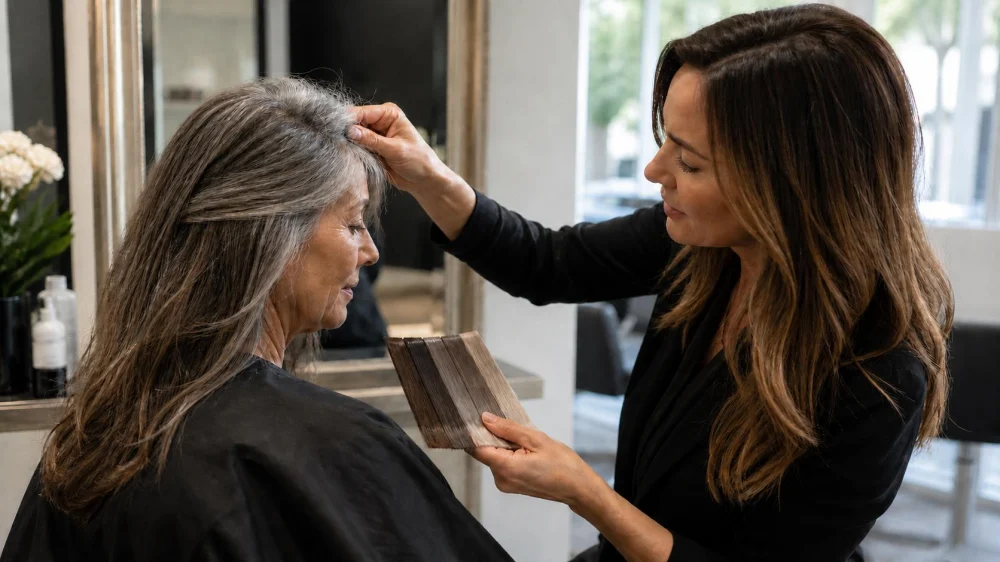
Gray Blending Consultation: Coverage, Contrast, and Upkeep
Table of contents
Quick answer: Gray blending is a consultation goal, not one universal formula. Decide whether you want less contrast, partial coverage, brighter silver, a softer part line, or a transition away from solid color. Ask the stylist to map your gray pattern, existing color, porosity, condition, haircut, and daily styling. Approve a realistic first session, maintenance schedule, home care, price range, and grow-out plan before color begins.

Define what “gray blending” means to you
Bring photos, but explain what matters: lightness, visible silver, soft roots, face framing, contrast, or finish. Different natural color, gray percentage, density, texture, lighting, and history make photos directional rather than guaranteed.
Choose a priority for the first appointment:
- soften the line between natural gray and previous permanent color;
- reduce contrast at the part and hairline;
- keep some natural depth while adding brighter pieces;
- cover only selected areas while leaving visible silver; or
- begin a longer transition toward mostly natural gray.
Share your return frequency, preferred warmth, usual texture, and styling time. A color that works after a salon blowout should also suit your routine.
Good Beauty Hair Salon Chicago
2777 N Milwaukee Ave, Chicago, IL 60647, USA
Map gray pattern, history, and condition
Gray rarely appears evenly. Check temples, hairline, part, crown, underside, and back in neutral light. Note white, salt-and-pepper, resistant, fine, coarse, or texturally different areas. Placement should follow the pattern.
Share permanent color, highlights, dark dye, henna, color masks, toners, relaxers, perms, keratin services, and home corrections. Dates and photos help because prior color changes future processing.
The stylist should assess elasticity, breakage, dryness, scalp, density, and root-to-length contrast. A strand test may reveal more. If one visit is unrealistic, discuss stages or a lower-impact goal.
Compare salon approaches and limits
Highlights can connect lighter gray strands through darker hair. Lowlights can return selected depth to very light areas. A root smudge or root blend may soften a line, while a gloss or toner can adjust the appearance of warmth and shine. Permanent color can provide more coverage but may create a stronger regrowth line than a translucent approach.
Labels do not specify formula or result. Ask which areas will be lightened, darkened, toned, or natural; how much gray stays visible; and what grow-out should look like. Confirm whether the base changes.
Darkened lengths may not become clean silver in one session, and porous sections may tone differently. Lighting and phone processing change photos. Agree on a target range and stop point.
Plan maintenance and grow-out
Ask about the next service, refresh options, and a longer wait. Maintenance depends on placement, contrast, growth, washing, heat, water, sun, and products; there is no universal interval.
Have the stylist separate essential home care from optional products. Confirm washing guidance, heat protection, color-depositing products, clarifying limits, and what to do if the tone becomes too warm, cool, dull, or violet. Do not layer corrective products without checking how they interact with the salon formula.
Request an itemized estimate for consultation, tests, lightening, color, toner, treatment, haircut, finish, extra product or time, and future maintenance. For a multistep transition, ask which result and cost belong to each session.
Review color safety before service
Tell the salon about prior reactions, scalp irritation, current skin problems, allergies, recent chemical services, and medicines or conditions your healthcare professional says matter. Ask which product directions, warnings, skin tests, and strand tests apply and when they must be completed. A successful prior service does not guarantee no future reaction.
The FDA's hair dye safety guidance advises following product directions and warnings, performing the recommended skin test before each dye use, not mixing different dye products, and rinsing the scalp well after dyeing. The salon should follow the exact manufacturer instructions for the products used.
During service, report burning, strong pain, swelling, breathing trouble, dizziness, or other unexpected symptoms immediately. Stop the service and follow appropriate rinsing, medical, or emergency guidance. A stylist can stop product application but cannot diagnose an allergic or scalp condition.
Frequently asked questions
Does gray blending cover every white hair?
Not necessarily. Many plans intentionally keep visible gray while reducing contrast. State the desired coverage area and opacity clearly.
Can dark permanent color become silver in one visit?
Sometimes the safe first-session result is limited. Existing pigment, banding, hair condition, and strand-test results determine what is realistic.
Will purple shampoo create gray blending?
No. A toning shampoo can alter some yellow appearance but does not reproduce strategic salon placement or remove dark permanent color.
Should the haircut happen before or after color?
Coordinate both plans. Major length, layers, bangs, or part changes can affect where color placement should be most visible.
Next steps
Bring reference photos, color history, routine, maintenance limit, and reaction history to the consultation. Ask the stylist to map gray distribution, test when needed, explain placement and visibility, estimate the first session and upkeep, and describe the grow-out. Approve the scope only when the expected range, safety steps, price, and follow-up plan are clear.

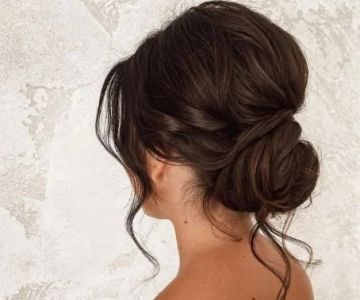


 ARCHIVE SALON4.0 (79 reviews)
 SalonDJ Hairtography4.0 (173 reviews)
 Kayla Mia Beauty5.0 (62 reviews)
 West Loop Gentlemen's Salon5.0 (21 reviews)
 Superior Barbershop4.0 (119 reviews)
 Pru/topia4.0 (15 reviews)
 Best Haircuts for Moms Who Want Style With Minimal Effort: Easy & Chic Ideas
 How to Choose a Haircut That Makes Your Face Look Slimmer
 Best Tips for Maintaining Healthy Scalp and Hair Growth in 2026
 Best Hair Color Trends for Fall and Winter in the US
 How to Turn a Basic Haircut Into a Signature Look with the Right Styling Tools
 How to Choose a Hair Salon Near Me That Offers Student or Senior Discounts