
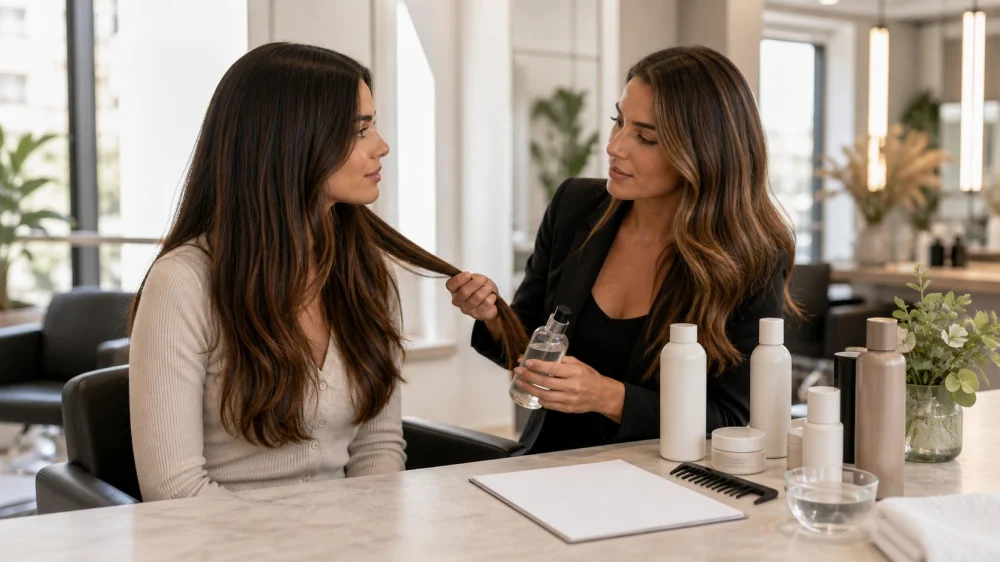
Salon Product Buildup Consultation: Plan a Gentle Reset
On this page
- Quick answer
- Define what “buildup” means
- Bring a complete product and service history
- Start with a hair and scalp assessment
- Understand the proposed salon service
- Protect color, texture, and extensions
- Simplify the home routine
- Separate cosmetic concerns from symptoms
- Questions to ask the stylist
- Consultation checklist
- Frequently asked questions
- Sources and evidence notes
- Conclusion and next steps
Quick answer
When hair feels coated, dull, sticky, limp, or difficult to style, book a consultation before requesting the strongest clarifying treatment. Bring a list or photos of every shampoo, conditioner, oil, dry shampoo, styling product, color service, and water treatment used recently. Ask the stylist to assess the scalp and strands, explain the proposed cleanser and timing, and protect color, curls, extensions, and fragile hair. Persistent itching, pain, sores, scaling, or sudden hair loss needs a dermatologist, not repeated salon cleansing.
“Buildup” is a descriptive salon term, not a medical diagnosis. Similar changes can come from product residue, oil, hard-water minerals, damaged hair, incorrect product amounts, or a scalp condition.
Define what “buildup” means
Describe the observable problem instead of only saying “buildup.” Note whether hair looks oily at the roots, waxy through the lengths, dusty from dry shampoo, flat after conditioning, rough after swimming, or flaky at the scalp.
Record when the change began and whether it appears immediately after washing or several days later. Mention odor, color shift, tangling, slow drying, or difficulty creating a lather.
Do not scratch, scrape, or repeatedly wash the scalp to prove residue is present. Photos in consistent natural light can help compare changes without aggressive handling.

Bring a complete product and service history
Photograph the front and ingredient label of products used during the past few weeks. Include masks, leave-ins, oils, pomades, gels, sprays, heat protectants, root cover products, and swimming or well-water exposure.
Tell the stylist about bleach, permanent or demi-permanent color, relaxer, perm, keratin service, extensions, wigs, or medicated scalp products. Include dates when possible.
Explain how much product is used, where it is applied, how often hair is washed, and whether products are rinsed out completely. A routine problem may be easier to fix than the hair itself.
Start with a hair and scalp assessment
Ask the stylist to look at roots, lengths, ends, elasticity, porosity, visible flakes, and breakage before shampooing. The plan should match the most fragile part of the hair.
The American Academy of Dermatology recommends choosing products for the hair type, washing according to how dirty or oily hair becomes, and applying shampoo primarily to the scalp. Those basic choices can matter more than adding another treatment.
If there is a heavy coating, the stylist may examine whether it changes with water, a regular shampoo, or a small controlled test. A cosmetic inspection cannot diagnose eczema, psoriasis, infection, or another condition.
Understand the proposed salon service
Ask whether the service uses a regular shampoo, clarifying shampoo, chelating product, pre-shampoo treatment, or another system. These terms are not interchangeable, and formulas vary.
Confirm the product directions, processing time, number of washes, water temperature, and conditioning step. More product or longer processing is not automatically better.
Request a small test section when the hair is fragile or the outcome is uncertain. Stop if there is burning, intense discomfort, or an unexpected change, and follow the product's safety directions.
Protect color, texture, and extensions
Clarifying or chelating may affect color tone, moisture feel, curl definition, adhesives, or extension maintenance. Ask what change is reasonably expected before approving the service.
For curly or coily hair, discuss detangling, conditioner, sectioning, and moisture restoration. AAD guidance notes that hair type affects wash frequency and how conditioner is applied.
Extension clients should follow the installation system's product rules and work with a trained professional. Do not soak bonds or apply unapproved solvents simply to remove a coated feeling.
Simplify the home routine
After the service, use the smallest number of products needed to meet the goal. Add products back one at a time so the effect is easier to identify.
Apply shampoo mainly to the scalp and let the lather move through the lengths during rinsing. Use conditioner where the hair needs it, following the formula and hair-type directions.
Dry shampoo absorbs oil but does not replace washing with shampoo and water. AAD advises applying it only where needed and washing hair after one or two dry-shampoo applications.
Clean combs, brushes, bonnet or pillowcase, hot-tool surfaces, and reusable product containers on an appropriate schedule. Do not dilute products unless the manufacturer instructs it.
Separate cosmetic concerns from symptoms
Persistent itching, pain, bleeding, crusting, open sores, marked redness, swelling, or a spreading rash should not be treated as ordinary residue. Pause salon experiments and seek medical advice.
Sudden shedding, bald patches, or progressive breakage also deserves evaluation. A board-certified dermatologist is trained to diagnose hair and scalp disorders.
If a cosmetic causes a serious reaction, get appropriate care and preserve the product name, lot information, receipt, photos, and timeline. Consumers can report serious cosmetic problems to the FDA.
Questions to ask the stylist
- What do you observe on the scalp, roots, lengths, and ends?
- Which product and process do you recommend, and why?
- How could the service affect my color, curls, texture, or extensions?
- Will you use a test section or adjust the plan if hair feels fragile?
- What is included in the price, and is a blow-dry or treatment separate?
- Which home products should I pause, continue, or reintroduce later?
Consultation checklist
- Photos of the current concern in neutral light
- Product names, labels, frequency, amount, and application areas
- Dates of color, chemical, smoothing, and extension services
- Swimming, well water, water softener, and travel history
- Known allergies, fragrance sensitivity, and scalp symptoms
- Proposed service, test section, expected result, and possible tradeoffs
- Total price, appointment time, and aftercare instructions
- Plan for medical evaluation when symptoms exceed cosmetic care
Frequently asked questions
Is clarifying shampoo the same as chelating shampoo?
Not necessarily. Product claims and ingredients vary. Ask what the specific formula is designed to remove and follow its directions.
Can I clarify immediately after coloring?
Ask the colorist who performed the service. A strong cleanser may change the appearance or longevity of some color services.
Does dry shampoo clean the scalp?
No. Dry shampoo absorbs oil but does not remove oil, dead skin, pollution, or accumulated products the way shampoo and water do.
Should I keep clarifying until the hair squeaks?
No. A squeaky feel is not a universal safety or cleanliness target. Follow the product directions and stop if the hair or scalp becomes uncomfortable.
Sources and evidence notes
The American Academy of Dermatology provides hair-type, shampoo, conditioner, and gentle-care guidance in tips for healthy hair.
AAD explains what dry shampoo can and cannot do, plus recommended use and wash timing, in dermatologists' dry shampoo tips.
For unexpected reactions, the FDA explains what information to preserve and how consumers can report problems on its cosmetic complaint reporting page.
Conclusion and next steps
A useful buildup consultation turns a vague coated feeling into specific observations, product history, and a controlled service plan. Begin with the gentlest appropriate approach, protect previous salon work, and simplify the home routine so results can be tracked. If discomfort, scalp disease signs, or sudden hair loss are part of the picture, stop cosmetic trial and error and seek qualified medical care.
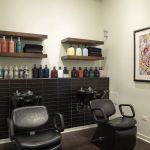 Sine Qua Non Salon4.0 (395 reviews)
 ALLEN HAIR DESIGN0.0 (0 reviews)
 Luquillo's Barbershop4.0 (7 reviews)
 HairMeOutMariah0.0 (0 reviews)
 Great Clips3.0 (105 reviews)
 Mario the barber1.0 (1 reviews)
 Best Ways to Keep Hair Color Vibrant for Longer Time
 How to Use a Hair Salon Near Me Review to Choose the Right Stylist for Your Hair Type
 The Best Haircuts Near Me for Straight Hair That Want to Try Soft Waves
 Best Salon Treatments for Maintaining Colored Hair That Actually Work
 What to Know About Booking a Haircut Near Me During Holiday Rush
 Best Ombre Styles That Are Still Popular in 2026 | Cary Hair Guide