
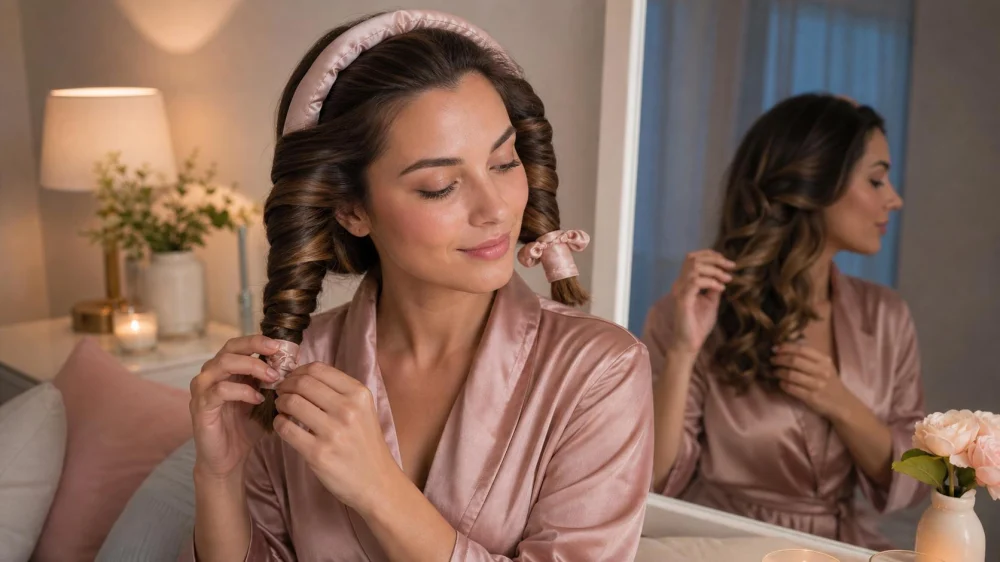
Heatless Curls Overnight: Check Dryness, Tension, Comfort, and Morning Removal
On this page
Quick answer
For overnight heatless curls, start with detangled hair that is dry or only slightly damp as appropriate for your texture, product, climate, and method. Divide even sections, wrap smoothly around a soft clean tool, secure without pulling the hairline, and test whether you can lie down without pressure points.
Remove the setup immediately if you feel headache, scalp pain, numbness, neck strain, tangling, or breathing obstruction. In the morning, unwind rather than pull, allow any remaining dampness to dry, then separate curls with fingers.

Choose a method for your hair and sleep
Soft foam rods, fabric tubes, a robe-belt style curler, braids, twists, and buns create different curl sizes and pressure. Match the tool diameter and section size to the desired pattern. Thick or dense hair may need more sections; fragile, chemically treated, tightly textured, or extension hair may need a gentler plan.
Consider sleeping position. A bulky tool across the back of the head may work for a side sleeper but not a back sleeper. Avoid rigid clips or hard ends at pressure points. Keep cords, loops, long ties, and loose fabric away from the neck and face.
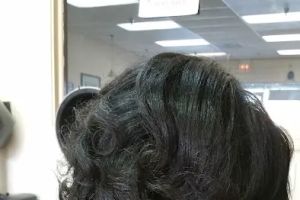
Prepare without excess moisture
Detangle from ends upward using the technique and tool suitable for your texture. Apply only the amount of approved leave-in or styling product needed for slip and hold. Heavy product can delay drying, create residue, or make sections stick together.
Hair wrapped very wet may remain damp by morning, especially in dense sections or humid conditions. Prolonged wet tension can feel uncomfortable and produce uneven results. Test the method during the day before relying on it overnight, and note how long your hair actually takes to dry.
Wrap with low, even tension
- Choose a clean soft tool with no rough seams or exposed fasteners.
- Create sections that match on both sides of the head.
- Smooth each section without stretching it tightly.
- Wrap ends flat so they are not folded sharply or trapped.
- Keep the setup away from delicate edges and recent scalp irritation.
- Secure with soft fabric ties or snag-free elastics, not tight rubber bands.
- Move your head in all sleeping positions and adjust pressure points.
- Use a breathable bonnet or scarf only if it stays comfortably away from the face and neck.
More tension does not guarantee longer-lasting curls. Hold comes from section size, dryness, product, wrapping pattern, and hair behavior as well as tension.
Remove and evaluate gently
Release ties and unwind each section in the reverse direction. Do not drag the tool through a curl. If hair catches, stop and separate the snag with fingers rather than pulling. Let damp sections finish drying before vigorous separation or brushing.
Use fingers or a wide-tooth tool to arrange the result. Record the tool size, section count, dampness, product amount, sleep comfort, dry time, and hold through the day. Change one variable in the next trial so you can learn what improved the outcome.
Overnight checklist
- Hair condition and desired curl size considered
- Soft clean tool inspected for rough parts
- Hair dry or only appropriately damp
- Products applied lightly and evenly
- Ends smooth and sections balanced
- Hairline and scalp free from pulling
- All sleep positions tested for comfort
- Loose ties kept away from face and neck
- Morning removal done by unwinding
Limitations
Heatless does not mean risk-free or guaranteed damage-free. Hair condition, porosity, texture, length, weather, product, tool, tension, and sleep movement change the result. Persistent scalp pain, hair loss, sores, or breakage warrants stopping the method and seeking professional or clinical advice.
FAQ
Should hair be wet?
Usually not soaking wet. Slight dampness may help some hair, but it must dry fully and remain comfortable.
Why are the ends frizzy?
They may have folded, escaped the section, lacked smooth wrapping, or been disturbed during removal.
Why did one side curl more?
Section size, wrap direction, moisture, tension, product, and sleep pressure may have differed.
Can I use a bathrobe belt?
Only if it is clean, soft, free of rough hardware, comfortable, and kept safely away from the neck and face.
What if my scalp hurts?
Remove the setup. Reduce tension or change the method; do not sleep through pain.
Evidence notes
Your most useful evidence is a repeatable trial log: hair condition, starting dampness, product, tool diameter, section count, wrap direction, tension comfort, sleep position, morning dryness, curl pattern, and breakage or tangling. Change one factor at a time.
Conclusion
Successful overnight curls depend on comfort as much as shape. Use a soft method, limited moisture, smooth ends, and low even tension; test every sleeping position; and unwind gently. A comfortable repeatable setup is more valuable than the tightest possible wrap.


 606 Esthetics5.0 (53 reviews)
 Andrea Hair x04.0 (4 reviews)
 Madison Sq Hair Salon5.0 (20 reviews)
 Karolina's beauty salon inc.4.0 (21 reviews)
 Bruhairia Boutique5.0 (2 reviews)
 Stylez by Steph5.0 (5 reviews)
 How to Use a Hair Store Near Me to Upgrade Your Haircare Game After a Big Cut
 How to Strengthen Weak Hair Naturally Without Expensive Products
 The Best Haircuts Near Me for Hooded Eyes and Visually Valuable Layers
 Changing Your Hair Part: Cowlick, Volume, and Training
 How to Find the Perfect Hair Salon Near You That Suits Your Hair Type
 How to Ask for a Balayage at Your Hair Salon Without Looking Over-Processed