
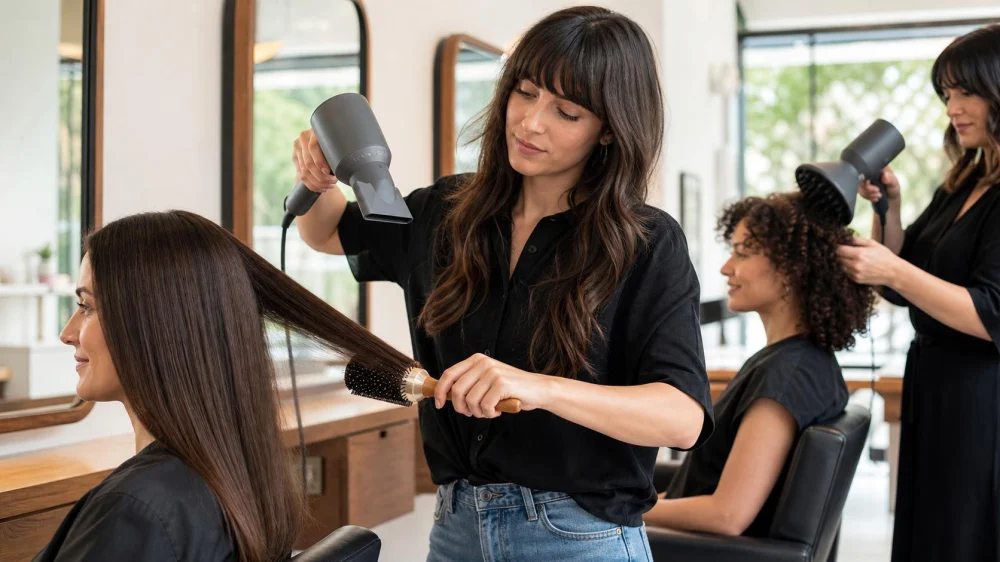
Hair Dryer Attachments: Choose a Nozzle or Diffuser
On this page
Quick answer
A concentrator nozzle narrows airflow for directional smoothing and brush work, while a diffuser spreads airflow to reduce disruption and support waves, curls, or gentle root drying. Start with towel-blotted, detangled hair, use the lowest effective heat and speed, keep the dryer moving, and stop if the scalp or hair feels uncomfortably hot. Technique matters more than attachment marketing.
Compare common attachments
A narrow concentrator creates a controlled sheet of air. It is useful for aiming from roots toward ends, smoothing sections, and keeping blast away from neighbouring hair. A wider concentrator covers more area with less precision. The nozzle should fit securely and remain aligned without wobbling.
A bowl diffuser with fingers spreads air across a larger surface and can lift hair near the scalp. A shallow diffuser may suit shorter lengths, while a deeper bowl can hold longer curls. A gentle-air attachment reduces direct force for sensitive scalps or fine hair. Comb or pik attachments create tension and require careful fit and technique.
Prepare damp hair
Remove excess water by blotting rather than rough rubbing. Detangle using the method appropriate for the hair pattern, starting at ends when needed. Apply only the amount of leave-in or styling product your hair and desired finish require. Too much product can lengthen drying, weigh down texture, or collect on the attachment.
Divide dense hair into manageable sections with smooth clips. Keep wet cords, towels, and products away from the dryer intake. Check that the filter is clean and the attachment is fully seated while the appliance is cool and unplugged. Follow the dryer manufacturer’s instructions because not every universal attachment fits safely.
Use a concentrator nozzle
Point the nozzle along the hair shaft rather than directly into the scalp. Keep a safe distance and move continuously. For brush styling, direct air toward the section under control and avoid pressing the hot nozzle against hair or bristles. Use smaller sections before raising heat.
Begin with roots and mid-lengths, then refine the ends. A brush creates tension; combine only enough tension and heat to shape the section without snagging. If the nozzle rotates or falls off as it warms, stop, unplug, let the appliance cool, and check compatibility rather than holding it in place by hand.
Use a diffuser
For curls and waves, set the pattern with product and minimal handling before drying. Hover the diffuser near the hair first, then cup sections gently when a more defined result is desired. Low or medium airflow reduces movement. Tilting the head can add root access, but choose a stable position that does not strain the neck.
Dry one area partly, then move. Constantly scrunching or rearranging can create frizz before the style sets. Stop around the desired dryness level and let hair cool before separating curls or adding volume. For straight or fine hair, the diffuser can still provide broad gentle drying without a concentrated blast.
Manage heat and airflow
The fastest setting is not always the best. High speed can tangle fine hair or break curl groups, while high heat can make the scalp uncomfortable and over-dry ends. Start lower, assess progress, and increase only when necessary. Use a cool or lower-heat finish if it supports the style and appliance design.
Stop for burning smell, sparks, intermittent power, unusual noise, a cracked cord, blocked intake, or an attachment that deforms. Unplug by the plug, not the cord, and let components cool on a heat-safe surface. Never operate a dryer near a filled tub or sink, and keep it away from children and pets.
Ask for a salon demonstration
Bring your dryer or a photo of its attachments if the salon permits. Ask the stylist to demonstrate section size, distance, heat, speed, hand position, and the point at which to stop. Record product amounts and order. A technique that works on freshly cut salon hair may need adjustment as length and weather change.
Discuss scalp sensitivity, extensions, chemical processing, breakage, and styling time. Ask for an alternative if the demonstrated neck position, brush grip, or drying duration is uncomfortable. A practical routine should fit your mobility, schedule, skill, and tolerance, not only the final photograph.
Frequently asked questions
Does a diffuser create curls?
It mainly preserves and supports existing wave or curl patterns by spreading airflow. Product, cut, moisture, handling, and natural texture all affect the result.
Can I use a concentrator without a brush?
Yes. It can direct airflow for rough shaping or root control. Keep it moving and point along the hair rather than holding concentrated heat in one place.
Why does my attachment fall off?
It may be incompatible, incompletely fitted, cracked, or changing with heat. Stop using it and verify the model-specific fit; do not tape a hot attachment to the dryer.
Evidence and limitations
This guide reflects common salon blow-drying practice and appliance safety principles: remove excess water, control sections, use the lowest effective settings, maintain distance, keep air moving, and follow manufacturer instructions. Hair condition, scalp health, extensions, appliances, and attachments vary. A stylist or clinician should assess breakage, pain, burns, or scalp disease.
Conclusion and next steps
Match the attachment to the desired airflow, inspect its fit, and start with prepared damp hair. Use a nozzle for direction or a diffuser for distributed airflow, then adjust section size before adding heat. Ask a stylist to demonstrate the exact movement so the home routine is comfortable and repeatable.
 A.S. African Hair Braiding shop4.0 (46 reviews)
 The Waxing Room4.0 (56 reviews)
 Hair by Galina MG4.0 (15 reviews)
 Frank's Barbershop5.0 (21 reviews)
 Haley's African Hair Braiding4.0 (142 reviews)
 YM Salon5.0 (3 reviews)
 The Best Haircut Ideas Near Me for Fine Straight Hair That Want Volume Without Layers
 How to Choose the Best Hair Stylist for Your Hair Type
 The Best Hair Cuts Near Me for Women Over 50 Who Still Want Trendy Styles
 How to Use a Hair Store Near Me to Build a Travel-Friendly Hair Kit
 Hair Color Looks Different Indoors? Check the Light Before a Correction
 How to Find a Hair Store Near Me That Offers Kits for At-Home Haircut Maintenance