
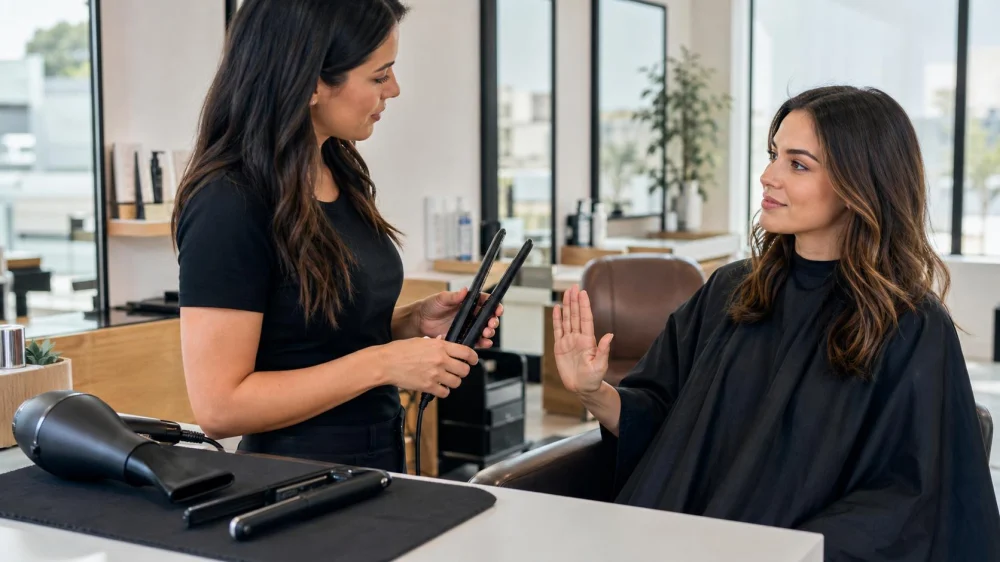
Salon Hot Tool Comfort: Heat, Scalp, and Stop Signals
On this page
Quick answer
Before blow-drying, flat ironing, curling, hot combing, diffusing, hood drying, or using another heated tool, tell the stylist about scalp sensitivity, hair breakage, chemical services, extensions, hearing aids, implants, skin conditions, burns, and products already on the hair. Ask for the lowest effective heat, limited repeated passes, and a clear signal that stops the tool immediately.
Heat should not feel painful or burn the scalp, ears, neck, or face. Say “stop” at sharp heat, burning smell, sizzling, smoke, pain, sudden pulling, or tool contact with skin. A finished style is not worth an injury. Persistent scalp symptoms or hair loss need medical evaluation.
Share your hair and scalp history
Tell the stylist when hair was colored, bleached, relaxed, permed, smoothed, pressed, extended, or chemically treated. Include recent breakage, shedding, fragile ends, scalp tenderness, sores, sunburn, dermatitis, alopecia, or a prior hot-tool incident.
Describe what usually works: low airflow, diffuser, no direct heat at the hairline, fewer passes, larger sections, partial air-drying, or avoiding a specific tool. Bring photos of damage or a product list when helpful.
Do not ask the stylist to diagnose a scalp disease or hair-loss cause. A board-certified dermatologist can assess symptoms and advise whether heat styling should pause.
Ask which tools and products are planned
Request the sequence: towel drying, blow-dry, round brush, diffuser, hood dryer, curling iron, flat iron, pressing comb, heated brush, or finishing tool. Ask how the stylist adjusts heat for hair condition and texture.
Ask about heat-protectant, setting spray, oil, dry shampoo, extension adhesive, and finishing products. Product buildup or flammable aerosol use near heat can create odor, smoke, residue, or risk. Follow each product and tool direction.
Clean, intact tools should have sound cords, stable plates or barrels, functional controls, and safe stands. Do not use a tool with a damaged cord, cracked housing, sticky residue, or unreliable temperature control.
Agree on clear stop signals
Choose a verbal signal such as “stop now” and a hand signal in case dryers make speech hard to hear. The stylist should pause first and discuss second. Do not expect the client to tolerate escalating heat while the tool remains in place.
Tell the stylist if you have reduced scalp sensation, neuropathy, communication difficulty, or trouble distinguishing heat. A companion or alternative service may help, but professional and medical guidance should shape the plan.
Clients wearing hearing aids may need a plan for removal, safe storage, moisture, loud dryers, and communication. Never place a hot tool near a device without confirming safe clearance.
Watch distance, contact, and repetition
A blow-dryer should move and remain at a safe distance according to the tool and styling method. Concentrating heat on one spot can overheat the scalp and hair. Diffuser attachments must be secure.
Flat irons and curling tools should contact hair, not skin. Hair must be in the condition required by the tool; AAD advises using flat irons on dry hair at low or medium heat and limiting hot-tool use.
Repeated passes add exposure. If a section is not responding, pause to reassess size, moisture, product, tool condition, and realistic style goal rather than continuously reheating it.
Protect ears, neck, face, and devices
Ask the stylist to use appropriate combs, clips, guards, towels, capes, and hand positioning around the hairline. Ears should not be folded or trapped against a hot tool.
Remove or protect glasses, hearing devices, jewelry, hair accessories, and clothing only with the client's knowledge. Store small devices in a named case rather than a towel that could be shaken out or heated.
Keep heated tools on stable heat-resistant holders, away from cords, capes, aerosols, paper, towels, and water. A client should not be left alone with a tool touching the hair or near skin.
Respond to pain, burning, or damage
Stop the heat source immediately. If skin was burned, follow first-aid guidance and seek medical care based on severity. Do not cover a burn with styling product, oil, adhesive, dye, or another chemical.
If hair smells scorched, melts, becomes gummy, snaps, smokes, or changes texture suddenly, stop further passes and chemical services. Photograph the affected area and record products, tools, timing, and symptoms.
Seek urgent care for severe burns, blistering over a large area, face or eye involvement, electrical injury, smoke inhalation, or another emergency. See a dermatologist for persistent scalp pain, sores, inflammation, breakage, thinning, or hair loss.
Frequently asked questions
What temperature should a salon iron use?
There is no universal number for every tool, hair type, and condition. Ask for the lowest effective setting and follow manufacturer and professional guidance.
Is one pass always safe?
No guarantee applies. Hair condition, tool temperature, moisture, product, tension, and contact time all matter.
Should flat irons be used on wet hair?
AAD advises using flat irons on dry hair. Follow the tool's directions and the stylist's professional assessment.
Can I ask the stylist to skip hot tools?
Yes. Discuss air-drying, roller sets, wraps, braids, diffusing at lower heat, or another style that meets your needs.
Why does my scalp feel hot under a hood dryer?
Tell the stylist immediately. Airflow, position, heat, device function, products, and scalp sensitivity may need adjustment.
Official source and medical limits
The American Academy of Dermatology's heat-styling guidance says excessive heat can damage hair, recommends partial air-drying and less frequent blow-drying, and advises low or medium heat for flat irons used on dry hair.
AAD's healthy-hair tips recommend limiting heated tools and using low or medium settings and heat protection. This guide cannot select a safe temperature, diagnose injury, or override tool instructions, salon licensing rules, or a dermatologist's plan.
Next steps
Before the appointment, write down recent chemical services, scalp issues, device needs, and your stop signal. Ask the stylist for the tool sequence and lowest effective heat plan. During service, speak up at the first sharp heat or pulling, and stop entirely if skin or hair shows damage.

 Rich and Beautiful Hair5.0 (28 reviews)
 Indi Salon5.0 (9 reviews)
 Loc'd with Nae0.0 (0 reviews)
 Posh Hair Design4.0 (10 reviews)
 Milan Laser Hair Removal4.0 (440 reviews)
 KMB Grooming Lounge5.0 (2 reviews)
 How to Transition Your Haircut for Near Me Into a Vibrant Colour Without Damage
 How to Use a Hair Salon Near Me Review to Choose the Right Stylist for Your Hair Type
 How to Use Reviews to Filter Out “Bad” Hair Salons Near Me Before Booking
 How to Build a Minimalist Hair Store Near Me Shopping List That Still Covers Everything
 How to Rebuild Damaged Hair Structure Naturally
 How to Pick a Hair Store Near Me That Lets You Try Before You Buy