
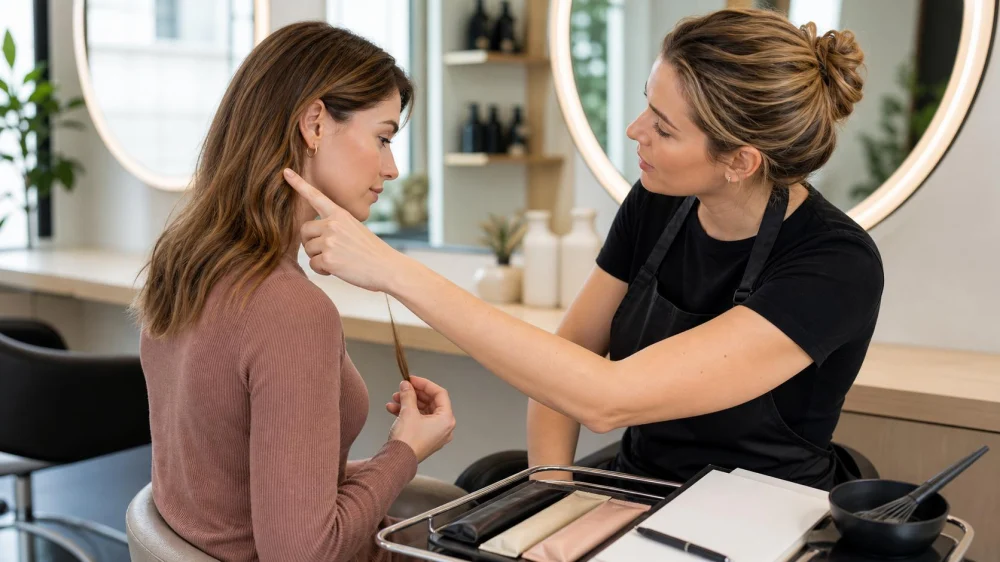
Salon Hair Color Tests: Ask About Skin and Strand Checks
On this page
- Quick answer
- Separate the skin test from the strand test
- Ask which exact products will be used
- Schedule testing before the service day
- Record hair, scalp, and reaction history
- Understand what a clear test cannot guarantee
- Respond to irritation or an unexpected result
- Frequently asked questions
- Official source and medical limits
- Next steps
Quick answer
Before booking hair color, ask the salon whether the product labeling calls for a preliminary skin test, how and when the salon follows those directions, and whether a separate strand test is recommended for the color goal and hair history. A skin test screens for a possible reaction under the product's instructions; a strand test checks a small section of hair for processing behavior, color direction, timing, and condition.
They are not interchangeable. FDA advises doing a skin patch test every time before dyeing hair because sensitivities can develop and formulations can change. Even a test without visible reaction cannot guarantee that full application will be reaction-free. Follow the exact product and salon protocol; do not improvise a test formula at home.
Separate the skin test from the strand test
A preliminary skin test applies the product in the specific location, amount, preparation, and time stated by the manufacturer. Its purpose is related to skin sensitivity or reaction risk. The salon should use the exact product components intended for the service when the label requires it.
A strand test uses a small, usually less visible section of hair. It can show how previous color, lightener, relaxer, perm, heat, minerals, porosity, gray coverage, and natural pigment affect the result. It can also reveal breakage or an undesirable color direction before treating the whole head.
A strand test does not screen the body for allergy, and a skin test does not predict the final shade or hair strength. Ask for both when the product directions and service plan call for them.

Ask which exact products will be used
Request the brand, product line, shade family, developer or activator, lightener, toner, direct dye, bonding product, and any additive or treatment planned. The final formula may include several products with different warnings.
Tell the stylist about known reactions to hair color, black henna temporary tattoos, cosmetics, adhesives, fragrances, preservatives, gloves, or salon products. Bring photos of labels or medical notes when available, but do not self-diagnose the responsible ingredient.
If the salon changes the product or formula after testing, ask whether the manufacturer requires a new skin test or strand test. “Similar color” does not mean identical formulation.
Schedule testing before the service day
Contact the salon early. A label-directed skin test requires a defined observation period, and a strand test may need drying and evaluation. Testing immediately before full application may not meet the product instructions.
Ask where testing occurs, who performs it, what the fee is, how the result is recorded, and what happens if the service changes. Keep the test site undisturbed according to instructions and report any reaction.
Do not schedule color right after bleaching, relaxing, perming, sunburn, scalp injury, or another process without professional review and product directions. FDA advises waiting at least 14 days after bleaching, relaxing, or perming before using hair dye and not dyeing an irritated, sunburned, or damaged scalp.
Record hair, scalp, and reaction history
Prepare a dated history of permanent, demi-permanent, semi-permanent, direct, metallic, henna, plant, progressive, at-home, and salon color. Include lightening, relaxers, perms, keratin or smoothing services, hard-water or mineral exposure, and color-removing products.
Describe scalp symptoms factually: itching, burning, rash, swelling, blisters, sores, scaling, hair loss, or prior medical treatment, with timing and product used. Tell the salon if the scalp is currently scratched, irritated, sunburned, or damaged.
A stylist can use the history to plan or decline a service, but a clinician diagnoses allergy or skin disease. Seek medical advice when a prior reaction was significant or the cause is uncertain.
Understand what a clear test cannot guarantee
FDA notes that a reaction can occur during full hair dyeing even when the preliminary skin test showed no reaction. Exposure area, amount, timing, product contact, and individual sensitivity can differ.
A strand that looks strong does not prove every section will process identically. Hairline, crown, ends, previously lightened areas, extensions, and gray hair can behave differently.
Use test results to reduce uncertainty, not to promise a perfect shade, zero damage, or zero reaction. Confirm the salon's stop criteria, alternatives, and correction policy before proceeding.
Respond to irritation or an unexpected result
If a skin test causes rash, swelling, itching, burning, blisters, or another reaction, do not proceed with the dye. Follow the product instructions, contact the salon, and seek healthcare advice. For trouble breathing, facial or throat swelling, faintness, or another severe reaction, seek emergency help.
If a strand becomes gummy, breaks, overheats, discolors unexpectedly, or fails to reach the goal, stop and revise the plan with the stylist. More time or stronger product is not automatically the answer.
Keep product names, lot information, photos, timing, and medical records. FDA asks consumers to report cosmetic adverse events after obtaining needed medical care.
Frequently asked questions
Do I need a patch test if I used the color before?
FDA advises testing every time because sensitivity can develop and formulations may change. Follow the current package directions.
Can the salon test behind my ear immediately before color?
The timing and site must follow the exact product instructions. An immediate test may not provide the required observation period.
Does a strand test show whether I am allergic?
No. It tests hair behavior and color, not whole-body allergy risk.
Can a stylist test several colors in one strand?
The stylist may design a professional test, but each product's directions and the service goal matter. Do not combine products contrary to labeling.
Should hair dye be used on eyebrows or eyelashes?
FDA warns not to use ordinary hair dyes on eyebrows or eyelashes because of serious eye injury risk. Follow only products and professional uses specifically permitted for that area.
Official source and medical limits
FDA's hair dye safety guidance advises following label directions, doing a skin patch test every time, avoiding damaged or irritated scalp, keeping dye away from eyes, wearing gloves, observing processing time, and reporting reactions after seeking medical care.
This article does not provide a patch-test recipe, diagnose allergy, or decide whether coloring is safe for an individual. The product label, manufacturer, licensed salon professional, and healthcare provider should guide the plan. Local salon rules and cosmetology requirements vary.
Next steps
Send the salon your hair and reaction history, ask for the exact product list, and book testing early enough to follow every label interval. Photograph the test record, confirm the full-service formula has not changed, and postpone color if the scalp or test site is irritated or the strand result is unsafe.


 The Beis Space5.0 (24 reviews)
 Salon JP4.0 (54 reviews)
 Salon La Rouge4.0 (48 reviews)
 Hair Sparkle4.0 (63 reviews)
 mikes hair design4.0 (140 reviews)
 Match Hair Salon - Chinatown Chicago5.0 (32 reviews)
 The Best Haircut Products You Can Buy at a Hair Store Near Me That Work Immediately
 The Best Hair Store Near Me for Affordable Options That Still Suit Professional Looks
 How to Use a Hair Store Near Me to Stock a Travel-Friendly Hair Kit for Weekend Getaways
 How to Choose the Right Hair Salon Based on Its Social Media Before Visiting
 The Hidden Benefits of a Blow-Dry Bar Versus a Full Hair Salon Near You
 Best Hairstyles for Work That Look Professional and Stylish: Modern Office Guide