
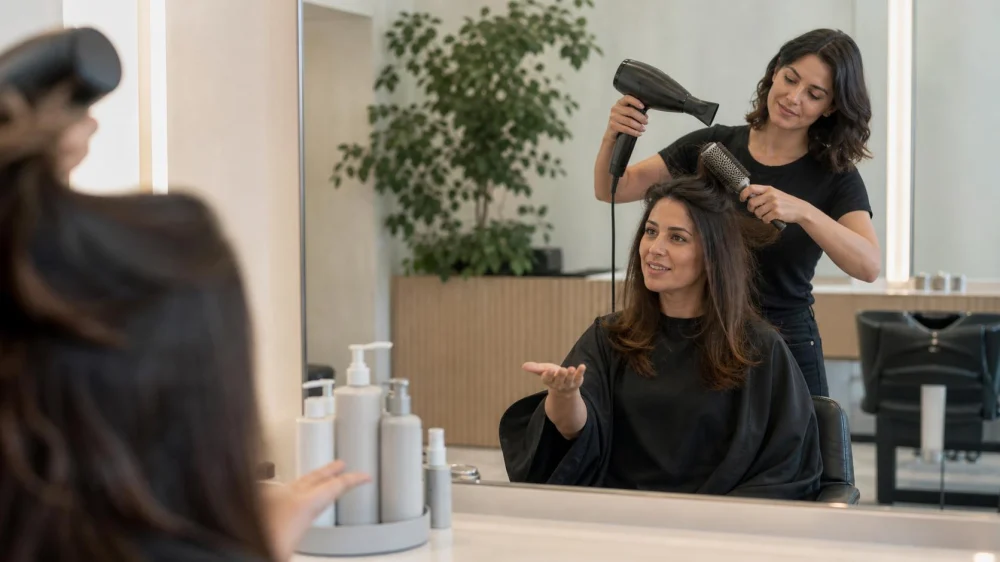
Salon Blow-Dry Plan: Heat, Tension, Products, and Finish
On this page
Quick answer
Before the blow-dry begins, describe your desired movement, volume, smoothness, curl, and part, plus any scalp sensitivity, fragile areas, extensions, recent chemical service, or product restrictions. Agree on heat and brush tension, ask what products will be used, and speak up immediately about burning, pulling, tangling, or discomfort. Check the shape from several angles before the final spray and record useful details for next time.
Why the finished look depends on decisions made before drying
A blow-dry combines moisture level, airflow, heat, section size, brush shape, tension, direction, products, and the hair's current condition. The same reference photo may require a different method on another density, texture, length, cut, or chemical history. Clear priorities help the stylist choose a realistic finish without treating discomfort as a necessary part of the service.
This guide is for United States salon clients receiving an ordinary professional blow-dry or blowout. It is not medical, dermatologic, chemical-service, extension-manufacturer, or tool-operation advice. Active scalp disease, injury, unexplained hair loss, or a recent procedure may require clinician or specialist guidance before service.
Practical checklist
- Desired finish including smooth, straight, curved ends, waves, curls, volume, root direction, part, face framing, polish, movement, and longevity.
- Hair density, texture, porosity, current dryness, breakage, tangles, short regrowth, fragile edges, extensions, wigs, hairpieces, and recent shedding changes.
- Recent colour, bleach, relaxer, perm, keratin or smoothing service, heat exposure, swimming, medication or health changes, and stylist aftercare instructions.
- Scalp tenderness, sores, irritation, burns, headache or neck concerns, sensory preferences, heat tolerance, and a clear signal to pause or stop.
- Cleanser and conditioner already used, leave-in, heat protectant, mousse, cream, oil, serum, fragrance, aerosol, hold product, and allergy concerns.
- Dryer temperature and airflow, nozzle or diffuser, round or paddle brush, comb, clips, section size, tension, cool setting, and finishing iron use.
- Service price and time, product or hot-tool add-ons, humidity and weather, travel after the visit, nighttime protection, and next-day expectations.
Step-by-step plan
- Show one or two useful references and state the most important finish priorities plus what you do not want, such as flat roots or rigid ends.
- Tell the stylist about chemical history, extensions, fragile areas, scalp sensitivity, allergies, and any product or fragrance restrictions before application.
- Agree on a comfortable starting heat and tension, tool plan, product sequence, part, and a simple stop signal that can be used during noisy drying.
- During rough drying and section work, report hot spots, pulling, snagging, neck strain, or sensory discomfort immediately so the technique can be adjusted.
- Check the emerging shape at the front, sides, crown, and ends, then request small changes before heavy finishing product or extra hot-tool work.
- Ask which products were used and how much, whether the finish depends on weather or wrapping, and what gentle refresh method suits the style.
- Photograph the finished shape with permission and note the part, brush or diffuser choice, heat comfort, products, timing, and changes for the next appointment.
Save the date, stylist, starting hair condition, desired finish, reference photos, part, drying method, comfortable heat and tension, brushes or diffuser, products, hot-tool additions, total cost, weather, how long the result lasted, scalp or hair response, and adjustments requested for next time.
Limits and important notes
Do not accept burning, painful pulling, repeated snagging, visible smoke, or continued heat on one spot. A heat protectant does not make unlimited heat harmless, and a photo cannot guarantee an identical result. Do not apply an unknown product when allergy or fragrance avoidance has not been addressed, and do not hide extension or chemical history.
Ask the stylist to stop for sharp pain, burning sensation, dizziness, breathing symptoms, sudden scalp irritation, equipment sparks, smoke, or an extension attachment being pulled. Seek medical advice for a burn, significant allergic symptoms, open skin, or unexplained shedding, and emergency care for breathing difficulty, facial swelling, faintness, or another severe reaction.
Frequently asked questions
Should a blow-dry hurt at the roots?
No. Some controlled tension may be used, but pain, repeated pulling, or snagging should be reported immediately and adjusted.
Can I ask for lower heat?
Yes. Discuss heat comfort and hair condition; the stylist can adjust temperature, airflow, section size, timing, and technique.
Do I need every finishing product offered?
No. Ask what each product contributes and choose according to your finish, fragrance, allergy, buildup, and maintenance preferences.
When should I check the final shape?
Review it before heavy finishing spray and again at the end, using mirrors to see the sides, crown, back, and ends.
Will the blowout match the reference photo exactly?
Not necessarily. Cut, density, texture, length, condition, weather, and available time influence the achievable result.
Sources and evidence
Use the salon's service description, the stylist's consultation and product disclosures, current tool and hair-product directions, extension or chemical-service aftercare, and clinician guidance for scalp or allergy concerns. Those current, individual instructions override a generic styling guide.
Conclusion and next steps
Bring a focused reference, disclose condition and restrictions, agree on heat, tension, tools, products, and a stop signal, then communicate during drying. Review the shape before final product, save the useful details, and seek appropriate help rather than continuing through pain, burning, equipment trouble, or a significant reaction.
 Justin Hawkins Barber @ Rockstar Barbershop4.0 (15 reviews)
 Henry'S BARBER SHOP4.0 (10 reviews)
 Next Level Salon5.0 (12 reviews)
 A-List Xperience0.0 (0 reviews)
 Amelia Rose Studio4.0 (3 reviews)
 Eva’s hair cut #25.0 (7 reviews)
 How to Choose a Hair Store Near Me That Truly Understands Your Hair Needs
 The Best Hair Store Near Me for Affordable Options That Still Suit Professional Looks
 The Truth About Hair Loss Searches & What Your Stylist Wishes You Knew
 How to Style Long Hair Without Heat Tools for a Natural Look Guide
 How to Shop at a Hair Store Near Me for Tools That Suit Travel and Weekend Trips
 The Hidden Costs of a Haircut at a Hair Salon Near Me (And How to Avoid Them)