
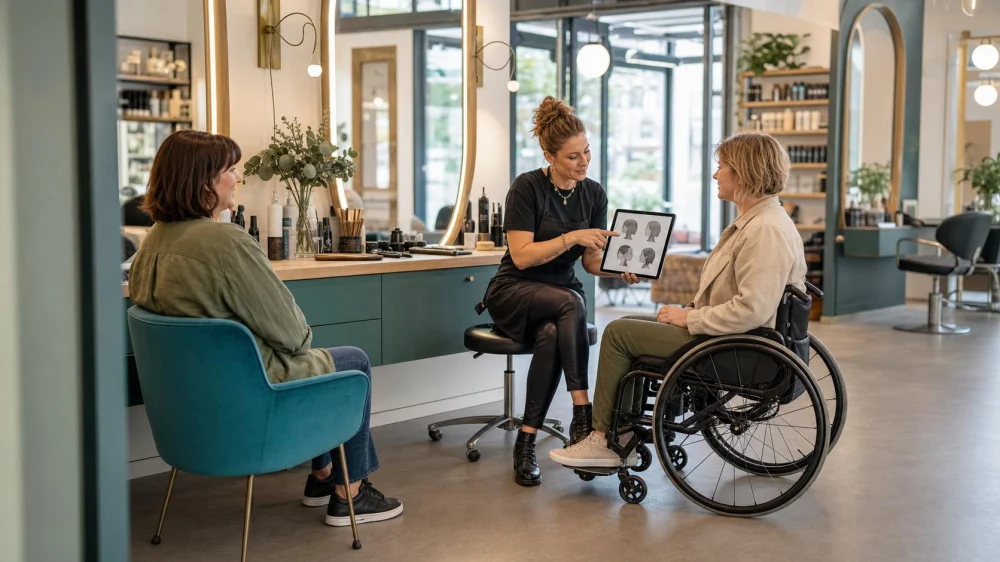
How to Plan an Accessible Hair Salon Appointment
On this page
- Quick answer
- Describe access needs, not diagnoses
- Verify the physical route and station
- Plan communication and sensory support
- Adapt the service sequence
- Coordinate companions and service animals
- Confirm the plan in writing
- Appointment checklist
- Limitations and safety notes
- Frequently asked questions
- Accessibility notes
- Ask for a five-minute planning call
Quick answer
Contact the salon before booking and describe the access conditions that affect the visit: step-free entrance, door width, accessible parking or transit, restroom, waiting area, space beside the chair, transfer needs, head or neck positioning, communication format, lighting, noise, fragrance, breaks, support person, or service animal. Ask the salon to explain what it can arrange and document the agreed appointment time, service sequence, station, and staff contact.
You do not need to disclose an entire medical history to ask for practical access information or a reasonable modification.
Describe access needs, not diagnoses
Use specific, action-oriented statements: “I remain in my wheelchair,” “I need written price and service steps,” “I cannot tilt my head into a standard shampoo bowl,” or “I need a low-noise time and permission to take short breaks.” This helps the salon assess its space and workflow without guessing from a diagnosis.
Ask what information the stylist genuinely needs for product, positioning, communication, or emergency safety. Share allergies or medically important restrictions clearly, but protect unrelated private details.
Verify the physical route and station
Ask about the path from parking, curb, or transit stop to the entrance; thresholds, ramps, steps, door operation, elevator, aisle width, floor surface, and restroom. Confirm whether the salon chair can move and whether there is enough turning and working space around your mobility device.
Photos or measurements supplied by the salon may help, but an older website image is not proof of current access. If a route is complicated, request a brief pre-visit walkthrough or arrival contact. Do not accept being carried or transferred by untrained staff as an improvised solution.
Plan communication and sensory support
Choose the communication method that works for consultation, consent, price changes, and checking results. Options may include written notes, text, speech-to-text, clear face visibility, extra processing time, a quiet station, or an authorized interpreter or companion.
For sensory needs, ask about lower-traffic hours, music, dryer noise, lighting, mirrors, fragrances, spray products, capes, scalp touch, and waiting time. Request advance warning before water, heat, vibration, reclining, or unexpected touch. Bring personal sensory tools if safe and compatible with the service.
Adapt the service sequence
Ask whether shampooing can be modified, skipped, or done another way; whether a dry cut is suitable; whether the service can be divided into shorter appointments; and where rest breaks fit without affecting chemical-processing safety. The stylist should explain which requests change the result or fundamentally alter the service.
Discuss stable positioning and pressure points. The customer should direct any transfer method and bring trained assistance or personal equipment when needed. A salon worker should not attempt clinical lifting or handling outside their training.
Coordinate companions and service animals
If a support person will attend, define their role and ensure the salon reserves enough space. The customer—not the companion—should remain the focus of communication unless the customer asks otherwise.
Under the ADA, a service animal is not treated as a pet. Ask where the animal can remain safely away from hot tools, cords, chemicals, and moving chairs while staying with its handler. Emotional-support and pet rules can differ. Do not place an animal in a position that interferes with the service or creates a direct safety risk.
Confirm the plan in writing
Record date, arrival method, station, stylist, service, expected duration, breaks, communication plan, product restrictions, shampoo approach, companion or service animal, and total quoted price. Ask who to contact if the setup changes.
On arrival, restate the plan before caping or product application. If the assigned station or worker differs, pause and decide whether the agreed access can still be provided safely.
Appointment checklist
- Describe functional access and communication needs.
- Verify entrance, route, restroom, and station.
- Choose a lower-sensory time if helpful.
- Plan shampooing, positioning, and breaks.
- Clarify companion or service-animal space.
- Confirm products and medically important restrictions.
- Get service, timing, setup, and price in writing.
- Reconfirm before the service starts.
Limitations and safety notes
- This guide is not legal, medical, occupational-therapy, or architectural advice.
- Accessibility duties and facility conditions depend on the facts and applicable law.
- Do not use unstable furniture, unsafe transfers, blocked exits, or improvised ramps.
- Stop a service for pain, breathing difficulty, faintness, a severe skin reaction, or unsafe positioning and seek appropriate help.
Frequently asked questions
Can I remain in my wheelchair for a haircut?
Ask whether the stylist can work safely around the chair with adequate access and whether mirrors, capes, and tool placement can be adjusted.
Can I ask for a quieter appointment?
Yes. Ask which time and station have less music, dryer noise, crowding, and waiting.
Must I explain my diagnosis?
Focus on the modification and communication you need; the salon may ask relevant safety questions.
Can a companion stay?
Discuss space and role when booking. A support person may be a reasonable part of effective access depending on the circumstances.
What if the salon cannot use its shampoo bowl?
Discuss a safe alternative service sequence or another accessible provider rather than forcing painful positioning.
Accessibility notes
ADA.gov explains that businesses open to the public must communicate effectively and make reasonable modifications when needed for access, unless a change would fundamentally alter the service. Physical accessibility and service-animal requirements may also apply.
Ask for a five-minute planning call
Send the salon your three most important access needs and request a short call with the person who controls scheduling and station setup. Confirm the agreed solution by text or email before booking.

 Josh Lubin at Salon Lofts5.0 (5 reviews)
 ALLEN HAIR DESIGN0.0 (0 reviews)
 Sams hair salon4.0 (64 reviews)
 Blues Barber Shop4.0 (66 reviews)
 Elizabeth Marie Artistry0.0 (0 reviews)
 Coco's Beauty Bar1.0 (2 reviews)
 How to Find a Hair Salon Near Me with Excellent Reviews for Curly Hair
 Mother-Daughter Hair Salon Visit: Tips for Finding the Right Hair Salon Near Me for Both
 How to Stop Frizzy Hair After Washing Without Using Heat Tools
 The Best Hair Store Near Me for Transitioning to Natural Hair Without Stress
 How to Use Reviews to Filter Out “Bad” Hair Salons Near Me Before Booking
 How to Evaluate Your Upcoming Hair Salon Visit Like a Pro: Checklist Inside