
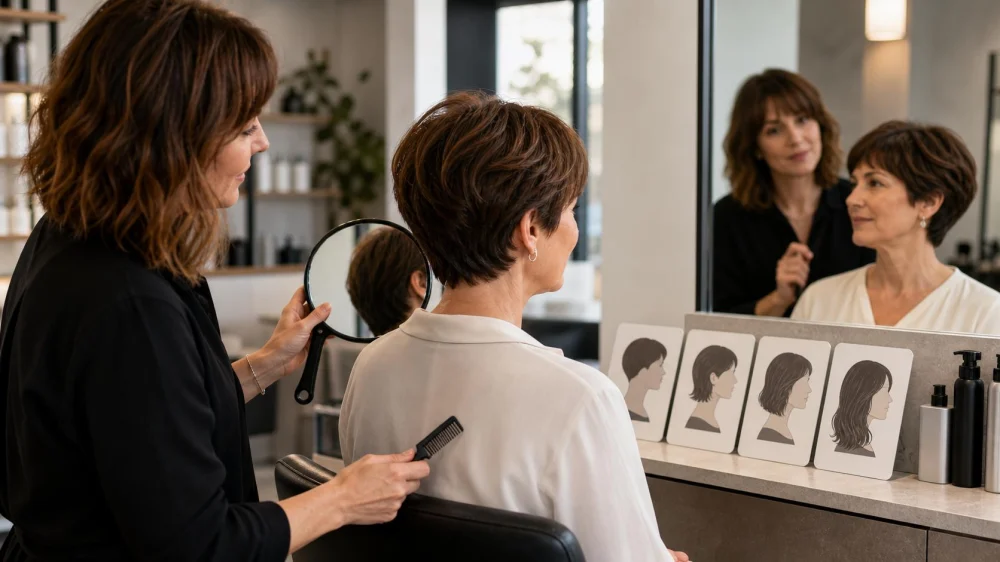
Short Haircut Grow-Out Plan: Shape, Styling, and Milestones
On this page
Quick answer
Grow out a short haircut toward a defined shape, not just “longer.” Show your stylist the target from several angles, identify which areas must gain length and which can be refined, then agree on visual milestones such as covering the ears, connecting the sides, softening a stacked back, or reaching a tie-back point. Schedule reviews by shape and manageability rather than a universal calendar.
This guide supports salon planning in the United States. Hair growth, shrinkage, density, curl pattern, breakage, color history, health, and styling habits vary. A stylist needs to assess the actual hair before recommending cuts, heat, color, or extensions.
Choose a target shape
A haircut grow-out plan is a sequence of temporary shapes that preserves needed length while keeping the current style intentional and manageable. The final target determines which sections should be protected now.
Bring front, profile, back, and texture references for a realistic goal. Look for hair with similar density, curl or wave, shrinkage, hairline, and styling effort. Identify whether the target is a longer pixie, bixie, bob, lob, shag, layered shape, one-length perimeter, or simply enough length to tie back.
State priorities: low daily effort, natural texture, tucked sides, no short fringe, reduced bulk, or fewer salon visits. A beautiful target that requires daily heat or products you will not use is not a useful plan.
Map the current haircut
Ask the stylist to describe the current longest and shortest zones, weight line, graduation, layers, undercut, fringe, sideburns, nape, cowlicks, and any disconnected sections. Take neutral photos while the hair is dry in its usual texture.
Mark the difficult behaviors rather than calling the whole stage awkward. The back may become heavy before the sides reach the ear. A fringe may enter the eyes before it can sweep aside. Curly sections may expand outward at a particular length.
Also note bleach, color, relaxer, perm, extensions, heat damage, breakage, or scalp concerns that affect what the hair can tolerate. Do not hide this history from the stylist.
Plan shape milestones
- Ear milestone: decide whether sides tuck, cover, or frame the ear.
- Fringe milestone: choose forward, curtain, side-swept, clipped, or blended direction.
- Nape milestone: decide whether to keep it neat, soften it, or preserve maximum length.
- Connection milestone: allow formerly disconnected top and side sections to begin blending.
- Perimeter milestone: establish the bob or longer outline without cutting every layer to one length immediately.
- Tie-back milestone: test which sections escape and whether accessories are comfortable.
Use photos and how the hair behaves as the milestone criteria. Calendar estimates can help with planning but should not control a cut when the shape has not reached the expected point.
Decide what to trim
Every trim should have a stated job: preserve the target, remove a damaged edge, control a nape, reduce a specific weight area, blend one disconnect, or reshape the fringe. Ask which length will be removed and how that supports the next stage.
Frequent full-shape trims can repeatedly reset the sections you are trying to grow. Avoiding all trims can leave damage, imbalance, or a shape that is difficult to manage. The right compromise depends on condition, goal, texture, and tolerance for temporary unevenness.
Consider a “do not cut” map in the salon notes. For example, preserve the shortest side layer while refining only the nape. Confirm the map again at every visit because a new stylist may interpret “tidy it up” differently.
Use styling to bridge stages
- Change the part. A different part can redistribute volume or help a fringe move aside.
- Test texture. Air-dried, diffused, stretched, curled, or smoothed finishes can create different silhouettes.
- Use accessories thoughtfully. Clips, pins, bands, or scarves should hold without sharp pressure, pulling, or breakage.
- Adjust product placement. Apply volume, control, or definition only where the stage needs it.
- Learn one fast option. Ask the stylist for a routine that works on an ordinary day, not only a salon finish.
- Photograph success. Save the angle, tools, and product amount that made a difficult stage work.
Use heat tools according to their instructions and your hair’s condition. More heat is not a substitute for a shape that matches the target and daily routine.
Grow-out checklist
- Final target shown from several angles
- Daily styling effort and texture preference defined
- Current short, long, damaged, and disconnected zones mapped
- Visual milestones chosen instead of fixed dates
- Protected “do not cut” areas recorded
- Purpose of each trim agreed before cutting
- Fringe, ear, nape, and tie-back strategies tested
- One simple at-home styling routine learned
- Progress photos taken in consistent conditions
Limitations and important notes
- Hair does not grow or retain length at one universal rate.
- Breakage, shedding, scalp changes, and chemical damage can alter the plan.
- Do not use tight accessories, repeated high heat, or aggressive detangling to force a temporary shape.
- Sudden or concerning hair loss, scalp pain, sores, or inflammation needs qualified medical evaluation rather than a styling solution.
- Extensions or chemical services add upkeep and risk and require direct professional assessment.
Frequently asked questions
Should I stop cutting my hair completely?
Not automatically. Agree on selective trims that protect needed length while addressing damage or a specific shape problem.
How often should I book a trim?
Use condition, manageability, and the next shape milestone rather than one fixed interval. Ask the stylist when to reassess.
Why does the back look longer first?
The starting cut, head shape, nape hairline, shrinkage, and shorter side sections can make growth appear uneven. A targeted nape plan may help.
Should I grow out bangs at the same time?
You can, but define how they will be parted, clipped, blended, or trimmed during the transition so they do not derail the overall shape.
Can color make the grow-out look more intentional?
It may change contrast or dimension, but color adds condition and upkeep considerations. Discuss the full service history and long-term goal first.
Sources and evidence notes
This article reflects general haircut consultation practice: define a target, map the existing structure, protect needed length, give every trim a purpose, use behavior-based milestones, and match styling to the client’s realistic routine. Exact timing and technique require direct evaluation by a qualified stylist.
Next steps
Take current front, side, back, and natural-texture photos. Choose one realistic target and identify the first visible milestone. Ask a stylist to mark which sections must grow and which may be refined, record the “do not cut” map, and learn one simple styling method for the next stage before booking the following review.





 Raze Up Barber Spa5.0 (5 reviews)
 Hair Cuttery Color & Haircuts - Broadview4.0 (215 reviews)
 Artsy Barber | Chicago Barbershop + Art Gallery5.0 (106 reviews)
 Hollywood Studios4.0 (13 reviews)
 Keeks Extensions0.0 (0 reviews)
 Michael Barber Studio 70.0 (0 reviews)
 How to Use “Haircuts Near Me” Search Results to Compare Pricing and Services | Find the Best Deals
 Best Haircuts Near Me for Removing Damage From Summer Highlights
 How to Use Reviews to Filter Out “Bad” Hair Salons Near Me Before Booking
 How to Strengthen Weak Hair Naturally Without Expensive Products
 How to Use Before-&-After Photos from a Hair Salon Near Me to Set Realistic Expectations
 How to Choose a Haircut That Makes Your Face Look Slimmer