
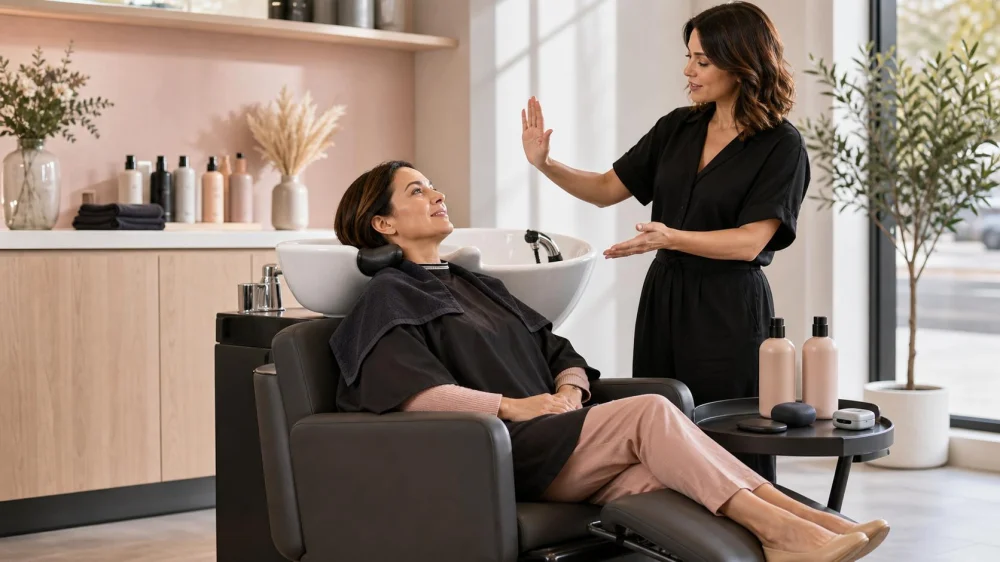
Salon Shampoo Bowl Comfort: A Client Communication Guide
On this page
- Quick answer
- Tell the salon before the appointment
- Check the chair and bowl setup
- Protect neck comfort
- Confirm water temperature and pressure
- Keep water away from the face and ears
- Review products and sensitivities
- Use clear stop and adjustment signals
- Plan for long or repeated rinsing
- Ask about alternative positions
- Speak up about symptoms afterward
- What salons can prepare
- Client checklist
- Frequently asked questions
- Next steps
Quick answer
Before shampooing, tell the stylist about neck, back, shoulder, jaw, balance, mobility, hearing, water, scent, skin, or positioning concerns. Ask how long the wash and rinse will take and whether the salon has a neck cushion, adjustable chair, front-facing wash option, handheld sprayer, ear protection, fragrance-conscious products, or planned breaks.
At the bowl, your neck should be supported without a hard edge pressing painfully, and you should not have to hold your head up by muscle effort. Confirm water temperature on a small area first. Agree on a clear stop signal, and speak up immediately about pain, dizziness, numbness, water near the face, breathing difficulty, or feeling unstable. A shampoo should not be endured silently.
Lucky Professional African Hair Braiding
1905 W 87th St, Chicago, IL 60620, USA
Tell the salon before the appointment
Call before booking if you have difficulty reclining, limited neck movement, recent surgery, chronic pain, vertigo, balance problems, a wheelchair, a medical device, or strong sensitivity to water or fragrance.
Describe the function you need rather than giving a diagnosis alone. For example: “I cannot tilt my head backward for more than two minutes,” or “I need to remain upright and transfer as little as possible.”
Ask whether shampooing is necessary for the planned service. Some cuts, styling, and consultations can be adapted, while color or chemical services may require thorough rinsing.
Confirm whether extra time or a different station is available. A quiet appointment slot can make adjustments easier than a tightly scheduled peak period.

Check the chair and bowl setup
The chair, footrest, bowl height, neck opening, and sprayer should work together. One fixed station does not fit every body.
Sit fully back with feet supported when possible. The stylist may adjust chair height, recline, footrest, or bowl angle. Do not slide forward until your lower back is unsupported just to reach the bowl.
Ask for a dry setup test before water starts. The stylist can check whether your head reaches comfortably and whether the cape, towel, and cushion stay in place.
If the setup feels unstable, stop. A towel stack is not always a safe substitute for equipment designed for support because it can shift or change neck position.
Protect neck comfort
The bowl edge should support the base of the head or neck as intended by the station without concentrating pressure on one painful point. Support needs vary.
A purpose-designed neck cushion may distribute pressure and reduce contact with a hard edge. It should be clean, intact, secure, and compatible with the bowl.
Keep the chin and head in the position the stylist requests only when comfortable. Do not force extreme extension to prevent water from escaping.
Ask for short returns to an upright position during a long service. Slow transitions can help if position changes make you lightheaded.
People with a medical or surgical neck concern should follow clinician guidance. A salon worker cannot determine which position is medically safe.
Confirm water temperature and pressure
Ask the stylist to test water temperature on the wrist, scalp edge, or another small area before saturating the head. “Warm” means different things to different people.
Tell the stylist if your scalp is tender, sunburned, recently treated, or unusually temperature-sensitive. Avoid assuming discomfort will improve once you adapt.
Sprayer pressure should rinse effectively without feeling sharp or forcing water under the cape. A clogged or irregular nozzle may need maintenance.
Water temperature can change when other fixtures operate. Speak up if it shifts. The stylist should recheck after pauses.
Keep water away from the face and ears
Tell the stylist if water near the eyes, nose, face, or ears causes anxiety or discomfort. A dry towel at the hairline or careful sprayer direction can help.
Ask about ear covers when appropriate, but confirm that they are clean and do not interfere with hearing devices, jewelry, piercings, or skin.
Remove hearing aids or protect them according to manufacturer and audiologist guidance. Store them in a labeled dry case under your control.
Keep eyes closed during rinsing and avoid sudden head movement. If water enters the face area, use the stop signal rather than sitting up abruptly.
Review products and sensitivities
Ask what shampoo, conditioner, toner, treatment, fragrance, or scalp product will be used. Bring a written list of known allergies or sensitivities.
“Natural,” “clean,” “hypoallergenic,” and “fragrance-free” do not guarantee that a product is safe for every person. Fragrance-free and unscented can also mean different formulations.
If you bring your own product, confirm salon policy and whether it is compatible with the planned service. The salon may not be able to guarantee results with an unfamiliar product.
Report burning, intense itching, swelling, breathing symptoms, or sudden discomfort immediately. The stylist should stop and follow the salon’s safety process; severe symptoms require urgent medical help.
Use clear stop and adjustment signals
Agree on a simple signal before reclining, such as raising the left hand. Talking can be difficult when water runs near the ears and face.
Use specific requests: cooler water, lower pressure, more neck support, less recline, a pause, or an upright reset. “I’m uncomfortable” is valid, but detail helps the stylist adjust.
The stylist should explain before moving the chair, adding product, changing temperature, or asking you to lift your head.
Do not wait until pain becomes severe. Small adjustments early are easier than recovering from a strained position.
Plan for long or repeated rinsing
Color, bleach, toner, smoothing, perm, extension, and treatment services may include several wash-bowl visits. Ask for the approximate number and duration.
Schedule upright processing time between rinses where the service permits. Maintain cape and towel dryness so repeated water exposure does not irritate skin.
Ask whether the salon can use a mobile basin, forward-facing shampoo method, handheld rinse at another station, or other professional adaptation. Not every method works with every product.
Do not shorten a safety-critical rinse to escape discomfort. Instead, improve positioning or choose a service plan the salon can complete thoroughly.
Ask about alternative positions
A client who cannot transfer safely may need service from their wheelchair or another stable chair. Confirm space, bowl reach, brakes, foot support, and transfer assistance in advance.
Salon staff should not perform lifts or transfers they are not trained or equipped to do. Bring an authorized support person if needed under the salon’s policy.
Front-facing shampooing can keep the neck more neutral for some clients, but it requires careful face, clothing, and water management. Ask whether staff are trained in the method.
Home-based or mobile salon services may be an option, but equipment, sanitation, licensing, and service limitations should be verified.
Speak up about symptoms afterward
Return upright slowly and pause before standing. Tell the stylist about dizziness, headache, neck pain, tingling, weakness, nausea, skin burning, or hearing-device concerns.
Do not drive until you feel steady and able to do so safely. Ask a support person for help when needed.
Persistent or severe symptoms require medical advice. Sudden weakness, trouble speaking, severe headache, chest pain, breathing difficulty, or another emergency symptom requires immediate emergency help.
Tell the salon what adjustment worked so it can be documented for future appointments with your consent.
What salons can prepare
Salons can train staff to ask about positioning, test the dry setup, check temperature, agree on stop signals, and document client preferences appropriately.
Inspect chairs, plumbing, sprayers, cushions, towels, anti-slip surfaces, and transfer space. Clean reusable supports between clients according to manufacturer and sanitation rules.
Keep paths clear and manage water promptly. Staff should know how to respond to a fall, allergic reaction, burn, equipment failure, or medical emergency.
Clear communication is part of service quality. A client request for a pause should not be treated as an inconvenience.
Client checklist
- Explain positioning limits before booking.
- Ask whether shampooing is required and how long it will take.
- Request a dry setup test.
- Confirm neck, back, and foot support.
- Test water temperature and sprayer pressure.
- Review products, fragrance, and sensitivities.
- Protect hearing devices and personal items.
- Agree on a hand stop signal.
- Take upright breaks during long services.
- Report symptoms before leaving.
Frequently asked questions
Should a shampoo bowl hurt my neck?
No. Mild unfamiliar pressure can occur, but pain, numbness, dizziness, or muscle strain calls for immediate repositioning or stopping.
Can I skip the salon shampoo?
Ask the stylist. Some services can be adapted, while color, chemical, or scalp services may require controlled washing and rinsing.
Can the stylist stack towels under my neck?
A small approved adjustment may help, but unstable stacks can shift. A compatible purpose-designed cushion or different station may be safer.
What if I cannot lean backward?
Ask about front-facing washing, an adjustable or mobile basin, service from a wheelchair, modified service, or a dry option where professionally appropriate.
Why do I feel dizzy when sitting up?
Position changes can have several causes. Sit up slowly, pause, and tell the stylist. Seek medical advice for recurring, severe, or concerning symptoms.
Next steps
Call the salon, describe your functional needs, and ask about the station and alternatives. At the appointment, test the dry position, water, and signal before starting. Request early adjustments and document what works for next time.
This guide provides general comfort and communication information, not medical advice. Follow guidance from your clinician and the salon’s trained staff for individual needs.




 Barber Shop 6064.0 (410 reviews)
 Alfredo's BarberShop4.0 (117 reviews)
 Rev. Billy's Chop Shop4.0 (243 reviews)
 Art + Science Salon4.0 (138 reviews)
 Salon Envy4.0 (164 reviews)
 Love Locs Just Natural Hair Salon4.0 (208 reviews)
 How to Use Social Proof (Reviews, Instagram) to Pick a Hair Store Near Me That Delivers
 How to Repair Split Ends and Avoid Them Until Your Next Haircut
 The Best Men’s Haircuts Near Me for Professionals: Sharp, Low-Maintenance Styles
 How to Style Medium Length Hair for a Polished Everyday Look
 How to Choose the Right Haircut for Travel Without a Full Salon Visit | Cary Hair Guide
 What to Ask at Your Hair Store Near Me When You Need Products for Colour-Treated Hair