
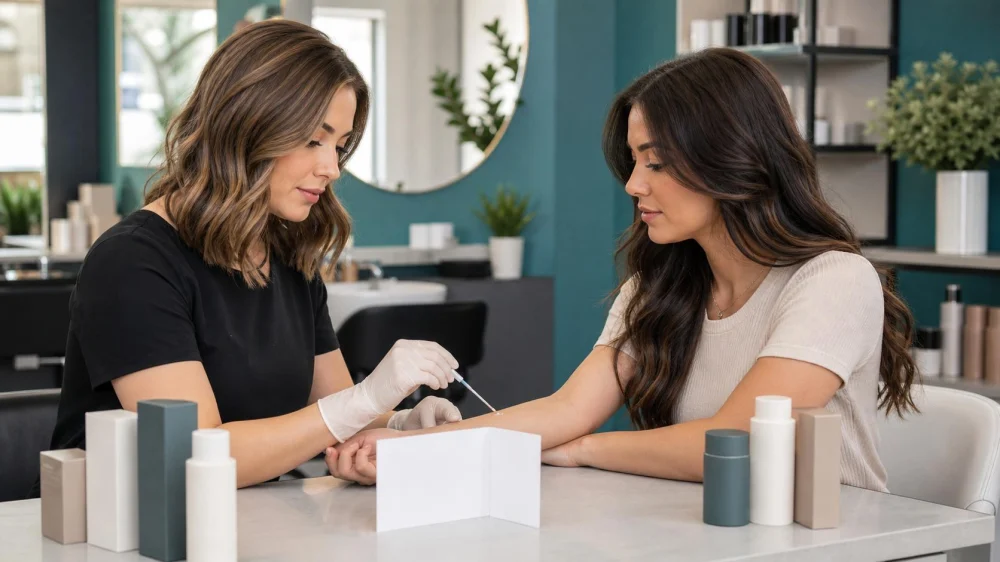
Hair Color Skin Test: Follow Product Directions Every Time
A previous trouble-free color service does not guarantee the next one will be reaction-free. Formulas can change, and sensitivity can develop after repeated exposure. Before every hair-dye service, identify the exact products, disclose prior reactions, and follow each manufacturer’s allergy alert or skin-test directions and timing. A salon test is a safety screen, not proof that a reaction cannot occur.
Quick answer
Tell the stylist about allergies, asthma, eczema, scalp disease, prior burning or rash, black-henna temporary tattoos, and every recent chemical service. Confirm the brand, shade, developer, and lot to be used. Perform the manufacturer-directed test every time, at the specified site and interval, without mixing your own method. Do not proceed after redness, itching, burning, swelling, rash, or another warning sign; contact a healthcare professional.
Share your history
Describe reactions to hair dye, bleach, relaxer, perm, cosmetics, adhesives, fragrance, temporary tattoos, or occupational chemicals. Note what happened, how soon, where it appeared, what treatment was needed, and whether a clinician identified an ingredient.
Bring ingredient lists or photos of previous products when available. “Ammonia-free,” “natural,” “organic,” or “plant-based” does not mean allergy-free. Do not ask the stylist to guess which ingredient caused a past reaction.
Identify the exact product
Record the full product line, shade, developer, lightener, additive, toner, and aftercare that may touch the skin. A test using one formula does not automatically cover another. Confirm that packaging is intact, in date, and supplied with directions and warnings.
Never mix different dye products unless that exact combination is specified by the manufacturer. Do not use scalp hair dye on eyebrows or eyelashes; the FDA warns that this can injure the eyes and may cause blindness.
Follow directions exactly
Use the manufacturer’s test site, preparation, amount, exposure, waiting period, and interpretation. Do not shorten the interval to fit an appointment or apply a larger amount for reassurance. Keep the sample away from eyes, children, pets, and other people.
A salon should schedule the test early enough to complete the required observation before service. Do not cover, wash, scratch, apply cosmetics, or treat the site unless the directions say to. Gloves and clean single-use applicators help prevent unintended exposure.
Read and record the result
Check at the specified times for redness or discoloration, itching, burning, swelling, rash, bumps, blistering, or pain. Photograph the site in consistent light if the salon policy and client consent allow. Record product details, test date and time, site, result, and who observed it.
A negative test does not guarantee the full service will be reaction-free. Proceed only when all directions permit, and retain the emergency plan. Never conceal a mild reaction with makeup or antihistamine simply to continue.
Check scalp condition
Before coloring, inspect for scratches, open sores, sunburn, rash, crusts, tenderness, or active irritation. FDA guidance says not to dye or relax hair when the scalp is irritated, sunburned, or damaged, and not to scratch or brush the scalp in the three days before dyeing.
Coordinate timing around bleach, relaxer, or perm according to product directions; FDA advises waiting at least 14 days after bleaching, relaxing, or perming before using dye. When instructions conflict, choose the more cautious path and consult the manufacturers or a qualified professional.
Stay alert during service
Protect clothing and skin, wear gloves as directed, keep dye away from eyes, and use a timer. Do not leave product on longer than instructed. Tell the stylist immediately about burning, stinging, itching, dizziness, coughing, eye irritation, facial tightness, or breathing changes.
Rinse the scalp thoroughly as directed. Do not add extra heat, cover the product, or change developer strength unless the instructions explicitly permit it. Keep ventilation comfortable and avoid eating or drinking around mixed chemicals.
Respond to a reaction
Stop the service and follow the product’s first-aid directions. For scalp or skin symptoms, rinse as directed and contact a healthcare professional. Save the packaging, ingredient list, lot information, timing, and photos so the clinician can evaluate the exposure.
Call emergency services for trouble breathing, wheezing, throat tightness, swelling of the face or tongue, fainting, severe dizziness, or rapidly spreading hives. For eye exposure, begin the label-directed rinse and seek urgent professional or poison-control advice.
Keep useful records
A salon record should include all formulas, ratios, lot details when available, test result, processing time, heat use, scalp observations, client-reported sensations, rinsing, and aftercare. Give the client product identification for medical follow-up.
After a reaction, do not retry the product or a “gentler” shade without healthcare guidance. A dermatologist or allergist may use formal diagnostic patch testing, which is different from the manufacturer’s pre-use screening.
Frequently asked questions
Do I need a test if I used the same dye before?
Yes. FDA recommends following directions and testing before every use because sensitivity and formulas can change.
Does a negative result guarantee safety?
No. Reactions can still occur during or after the full service.
Can hair dye be used on eyebrows?
Do not use scalp hair dye on eyebrows or eyelashes.
Is a salon skin test the same as a dermatologist patch test?
No. A clinical patch test is a diagnostic procedure performed and interpreted by healthcare professionals.
Next steps
Ask the salon for exact product details well before the appointment, read the manufacturer instructions, complete the required test on schedule, and postpone service after any warning sign. Keep the product record and seek medical guidance for suspected allergy.
Review the FDA’s official hair dye safety guidance.
 My Ambitious Beauty5.0 (5 reviews)
 Brows by Basia5.0 (46 reviews)
 Top Luxury Fades4.0 (72 reviews)
 Mario Novelli's Barber Salon4.0 (57 reviews)
 Beauti PRO4.0 (30 reviews)
 Cory Carr5.0 (2 reviews)
 The Biggest Hair Colour Mistakes People in the US Are Making in 2025
 Best Haircuts for Sensitive Scalps and Allergies: Tips and Recommendations
 How to Plan an Accessible Hair Salon Appointment
 How to Choose the Best Hair Stylist for Your Hair Type
 How to Use a Hair Store Near Me to Build a Minimalist Travel Hair Kit Under $100
 How to Choose the Right Haircut for Fluffy or Porous Hair That Needs Extra Care