
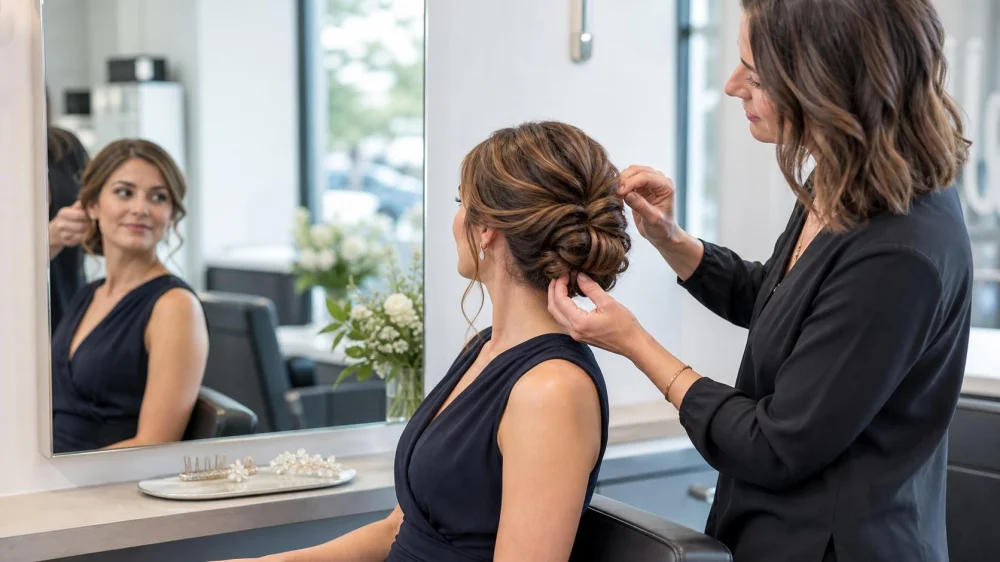
Formal Hairstyle Trial: Test Hold, Movement, and Removal
On this page
Quick answer
A formal hairstyle trial should test more than the front view. Bring the actual accessories and realistic references, describe the event length and setting, and agree on preparation. Check the style from every angle, move as you will at the event, identify pressure or pulling early, photograph it in several lights, record products and placement, and learn how to remove every pin and piece without tearing hair.
This guide helps U.S. salon clients plan an event style. Hair, scalp, service policies, weather, travel, accessories, and stylist methods vary. A trial reduces uncertainty but cannot guarantee identical event-day conditions.

Define the real event conditions
A formal hairstyle trial is a rehearsal that tests whether a chosen shape, attachment method, and finish fit the client’s hair, comfort, clothing, schedule, and event environment. It is not only a preview photo.
Tell the stylist the event date, location type, expected temperature or humidity, indoor and outdoor time, start and finish, travel, clothing neckline, headwear, dancing or movement, and whether the style must change later.
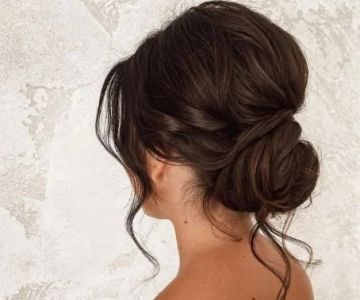
Choose priorities: height, softness, volume, smoothness, visible texture, face-framing pieces, ear coverage, accessory position, or durability. Also name what you do not want. A useful reference shows a similar angle and hair behavior, not just a celebrity face.

Prepare for the trial
- Ask whether to arrive with freshly washed, day-old, dry, stretched, or naturally textured hair.
- Bring honest information about current length, layers, color, extensions, chemical services, and scalp sensitivity.
- Bring the exact veil, comb, pins, clips, flowers, headband, or other accessory when available.
- Wear a neckline and collar similar to the event outfit.
- Bring earrings, hearing devices, glasses, or cultural and religious headwear that affects the style.
- List fragrance, adhesive, latex, metal, or product concerns before application.
- Confirm what the trial includes, how much time is booked, and whether a second look costs extra.
Do not make a major cut, color, chemical, or extension change immediately before the event without time to assess the result and adjust the styling plan.
Watch how the style is built
Ask the stylist to explain major sections: foundation, padding if any, extension pieces, anchor points, visible texture, accessory support, and finishing products. You do not need every technical detail, but you should know what is attached to your hair and how.
Notice how many pins or elastics create pressure, whether teasing feels manageable, and whether the style requires heat. Speak up immediately about sharp pin ends, scalp burning, excessive pulling, numbness, headache, or blocked hearing or vision.
Check that accessories are secure without damaging the piece or hair. Heavy ornaments may need a different support plan. Fresh flowers or materials supplied by another vendor need a handoff time and attachment method.
Test comfort and movement
- Look all around. Use two mirrors or a video to check crown, sides, back, hairline, and accessory angle.
- Turn and tilt. Move the neck slowly in the directions needed for conversation, photos, eating, and dancing.
- Sit and stand. Check whether a low style touches a chair, collar, or headrest.
- Add event items. Put on glasses, earrings, veil, jacket, or headwear in the planned order.
- Wait. Wear the trial long enough to notice pressure, loosening, flyaways, or product feel when salon policy allows.
- Check removal. Ask which item comes out first and how to find hidden pins without pulling.
“Secure” should not mean painful. If the style causes increasing discomfort during a short trial, it is not a good event-day plan without revision.
Photograph and document the result
Take front, profile, three-quarter, back, top, seated, and accessory-close-up photos with the stylist’s permission. Include natural light and indoor light because shine, gaps, color contrast, and flyaways can appear differently.
Record the agreed part, height, face-framing length, accessory orientation, visible pin color, extension details, product sensitivities, prep instructions, approximate build time, and planned arrival time. Ask the salon to keep its own notes and photos in the booking when possible.
Note requested changes in plain language and mark them on a photo. “Lower the right side by a small amount” is clearer than “make it more relaxed.”
Trial checklist
- Event setting, duration, travel, and activity described
- Hair history and current condition shared
- Actual accessories and similar neckline tested
- Product, fragrance, heat, adhesive, and metal concerns discussed
- Front, sides, back, and top reviewed
- Walking, sitting, turning, glasses, and earrings tested
- Pressure, pulling, pin ends, hearing, and vision checked
- Photos taken in more than one light
- Prep, timing, changes, and removal sequence recorded
Limitations and important notes
- Humidity, wind, rain, travel, and event length can change hold and texture.
- Do not ignore scalp burning, rash, swelling, breathing difficulty, severe pain, or other concerning reaction; stop the service and seek appropriate help.
- A trial on different hair length, color, extensions, or condition may not predict the final result.
- Do not sleep in a heavily pinned style unless a qualified stylist specifically planned it and it remains safe and comfortable.
- Confirm who owns, transports, places, and removes valuable or fragile accessories.
Frequently asked questions
How close to the event should I schedule the trial?
Choose a date that allows time for changes while keeping hair length, color, and accessories reasonably similar. Ask the salon based on its booking schedule.
Should I wash my hair before the trial?
Follow the stylist’s instructions for your texture, scalp, service, and products. “Dirty hair holds better” is not a universal rule.
Can I test two hairstyles?
Ask whether the booking includes one complete look, partial variations, or extra time and cost. Rebuilding can affect the second result.
What if the style looks good but hurts?
Ask for revision. Pain, sharp pins, or increasing tension are not acceptable tradeoffs for appearance.
Do I need the real accessory?
Bring it whenever possible because weight, comb shape, attachment, and proportions affect the build. Use measurements and clear photos if it is unavailable.
Sources and evidence notes
This article reflects general salon consultation and event-rehearsal practice: define real conditions, test actual accessories, communicate comfort limits, view the full style, document repeatable details, and plan safe removal. Exact products, methods, timing, and suitability require the stylist’s direct assessment.
Next steps
Gather three reference views, the actual accessories, a similar neckline, and a short event timeline. Book enough trial time, photograph the result from every angle, wear it briefly while moving, and write down one approved version plus specific changes. Share the final notes with the same stylist before event day.
 Union Shop Barbershop4.0 (39 reviews)
 Platinum Fades4.0 (190 reviews)
 Ellie Veikos Hair0.0 (0 reviews)
 Ricci Kapricci Fullerton4.0 (214 reviews)
 Joey'z Hair Cutz4.0 (118 reviews)
 Tom's Style World4.0 (49 reviews)
 How to Ask for a Balayage at Your Hair Salon Near Me Without Looking Over-Processed
 How to Choose a Haircut That Makes You Look Younger Instantly
 How to Pick the Right Haircut for Fine Hair That Actually Holds Style
 How to Choose a Haircut That Will Grow Out Nicely After a Colour Service
 How to Refresh Your Look With a Haircut Near Me That Costs Less Than $100
 Best Haircuts for Natural Hair: Shape, Texture, and Style Guide